
Monthly Archives: January 2012

How I’ve been spending my evenings and weekends

I looked at projected energy consumption totals for 125 countries that are not part of the OECD (except for Turkey, which I included in a fit of absent-mindedness) and have populations of over 1 million. In 2010, these 125 countries had a combined population of 5.66 billion, and a combined GDP of $18.6 trillion. By 2030, they will account for 6.96 billion people and their combined GDP is projected to be $36.84 trillion.

In 2006, these countries consumed 230.3 quads. The EIA projected (in 2010) that in 2030 these countries will consume 405.6 quads, a CAGR of 2.29%. My methodology indicates that these countries may well consume 636.2 quads, a CAGR of 4.15%.

That would permit the inference that global energy consumption will be closer to 936 quads than the EIA’s 2011 projection of 721 quads in 2030. The difference between the EIA’s estimate and ours—215.9 quads—is more than the current energy consumption of the U.S. and China combined. (I get to that total by assuming that EIA projections are accurate for the OECD at 278.7 quads and developing countries not included in my analysis, at 22 quads.)

What drives the difference? For 106 of the 125 countries, I paired these countries with other, similar, countries that had preceded them along the development path, and used historical figures of per capita energy consumption and per capita GDP to provide new figures. For the other 19 countries I was unable to find suitable pairings and took the EIA estimates instead.

The EIA calculated a 2.2% CAGR for the developing world in their 2010 report (and increased that to 2.3% for their 2011 update). My calculations, when including the countries where we accepted the EIA estimates, showed a CAGR of 4.15%. For the countries where I was able to find a paired country as an analogue, the CAGR was higher, at 5.07%.

The countries where I was unable to find an adequate ‘paired’ country had a 2006 energy consumption total of 33.9 quads and are projected by the 2010 EIA report to consume 58.3 quads. They included major energy producers such as Saudi Arabia, Venezuela and the United Arab Emirates, countries that are already consuming very large amounts of energy per capita. They also included high income states such as Taiwan and Singapore. In both cases I felt that I was unable to determine if further development would result in higher per capita energy consumption.

Thirteen of the countries I paired with examples yielded CAGR figures lower than the EIA. Almost all of those countries were Eastern or Central European states, including Russia. Their energy consumption in 2006 was 41.9 quads, and the EIA projected (in 2010) that their 2030 consumption would be 56.2 quads. My estimate for 2030 energy consumption for these countries was 50 quads.

The BRIC countries (Brazil, Russia, India and China) explain much, but by no means all of the discrepancy between the EIA’s projections and my own. According to my  projections, those four countries will account for 405.36 of the 636.2 quads from this set of developing countries. The EIA had projected (I infer, from the CAGR percentages applied to non-OECD nations) 243.2 quads from the BRICs.
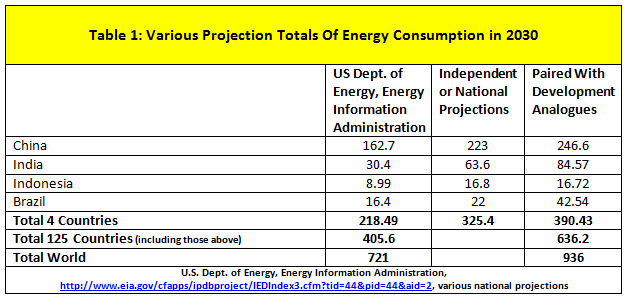
Projections of Future Energy Consumption

Both the U.S. Energy Information Administration and the International Energy Agency project robust growth for energy consumption over the next 20 years. However, their definition of ‘robust’ pales alongside the real-world growth experienced by developing countries in the wake of globalization. The EIA projects energy consumption in the developing world to grow at 2.2% annually (a figure they raised to 2.3% in September of 2011). What I hope to show is that, although that may be true for parts of the non-OECD world (Central and Eastern Europe, parts of Latin America and some oil-rich countries that are already consuming as much as they ever will), the parts of the developing world that are also growing rapidly will see their energy consumption rise by 5% per year. At which point the conversation transcends energy and even economics. Energy growth at that pace in Asia and Africa then becomes a political issue. Several political issues, actually.

It’s unfair, of course. The vast energy consumption by the rich world is now taken for granted in this discussion, simply because it has stabilized. Both the EIA and the IEA believe that energy consumption by rich countries will grow by between 0.3% and 0.5% annually over the next 20 years. But that flat line is at the top of a vast quantity of coal, oil, natural gas, nuclear power, hydroelectric power and trace amounts of wind and solar that combine to bring us a life we take for granted, and which we will go to great lengths to protect. We don’t want your territory and we’re willing to pay for your oil and natural gas—but don’t even think about pulling the plug on it. The principal policy question then becomes: now that we’ve got ours, can the world permit the have-nots to get theirs?

The EIA periodically projects future energy consumption for the world, and splits out OECD and non-OECD countries for detailed reporting. In their report, International Energy Outlook 2010, the section World Energy Demand and Economic Outlook uses a compound annual growth rate (CAGR) of 1.4% per year for increased consumption of energy worldwide (Remember that in 2011 they increased their projected totals by 5%). Using a variety of different methods and other reported figures for GDP growth and energy consumption, I will try to show that this figure is too low and offer a range of possible values that may be more useful for planners, politicians and other stakeholders making decisions based on future energy consumption.

At the heart of my higher projection of energy use in the developing world is a very simple observation: Development is a path travelled by many countries, and different countries are at different stages of that journey. By comparing future energy consumption for one country in the developing world to energy consumption in countries that have been at a similar stage in the recent past, I hope to offer a new perspective that may serve to anchor estimates to realistic boundaries.

At this point I should point out that others have remarked on the discrepancy between projections and performance as far as energy use is concerned. However, most of the discussion has been about China. This is natural, as China has outperformed everybody’s expectations and is very hard to ignore. But the fact is that what is happening in China is also happening in Indonesia, the Philippines, Brazil and India, and many other places as well. China is not the only country using energy faster than expected.

Useful Reports

A lot of useful material is available on the internet. However, sites get moved or abandoned, so I am uploading reports here so they’ll always be available.

After I post this I will push it down to the bottom of the blog. I will update it frequently, and am adding links to the reports on the rather longish list of links on the right-hand side of this blog.

Suggestions are welcome for reports to include. If those suggestions come with lengths or attached reports, they will be much easier for me to deal with (hint, hint.)

Energy_and_Environment_in_China, May 2011

International Energy Outlook 2011, DOE EIA

International Energy Outlook 2010, DOE EIA

The World in 2050, Price Waterhouse Coopers

BP Energy Outlook 2030

Energy Consumption in the Developing World in 2030

What does it mean to the world if we discover that developing countries may use 57% more energy in 20 years than previously calculated? Or that the world as a whole may use 30% more energy in 2030 than we are planning for now?

This world of 7 billion people is in the process of preparing for the next 2 or even 3 billion humans who will join us on this planet over the course of this century. For most of us, that preparation consists of taking care of our families and preparing the next generation to do well in an uncertain environment. For those in public service, the preparation also includes making sure their city, region or country is doing more than just surviving the current crises and perennial problems.

For a very few, this preparation centers on predicting the future—how many of us will there be, how the economic condition of the world will enable or handicap their development, who will be advantaged or disadvantaged by changes in the human population and their effects on this world.

This story is about forecasting energy consumption, which forms the basis for both educated guesses and confident predictions about GDP, development and public health. Energy is one of the base assumptions for what we think will happen. Energy, along with fresh water, are limiting factors—if we have enough of them, we can make other plans. Without adequate supplies, planning will be based on shifting sands.

Despite this, there really aren’t that many organizations making careful forecasts of energy consumption in the future, especially compared to the number of organizations that try to estimate economic growth. It is true that there are many companies, think tanks and government departments that are very interested in how much of what type of fuel will be available, where they can find it and how much it will cost. But once it’s out of the ground or into the fuel tanks and electricity grids of the world, their interest declines sharply. Supply is very important to these people. Consumption, not so much.

One exception to this is the U.S. Department of Energy’s Energy Information Administration. It was formed in 1977 as a response to the oil supply shock of 1973. It is the U.S.’s go-to source for data and information about energy use worldwide, as well as America. About 400 people work for the EIA and it has an annual budget close to $100 million. Perhaps because they are independent of political influence, they have a pretty good track record. They are highly respected and deservedly so.

(The other major provider of statistical information about energy use is the International Energy Agency, an inter-governmental organization set up in 1974 for pretty much the same reason as the EIA—to provide information to better deal with situations like the oil crisis that had just concluded.  But because they were formed as a policy tool to deal with oil supply disruptions, their numbers (which are not as easy to access as their American counterpart’s) are not always considered impartial and are not as widely used. For this article I focus on the U.S. Department of Energy’s Energy Information Administration’s figures.)

The end result of what both organizations do is hugely important to planners for the future. Those who are deciding where and how many power plants, dams, roads and wind turbines to build, how many roads, planes, pipelines and ships will be needed and for those estimating how to budget for provision of energy to tomorrow’s populations. Two million people download data from the EIA’s website every month.

I am one of them. I’ve been an energy analyst in the past, one of those who write incredibly long reports about things like ‘The Global Market for Energy Efficiency 2009-2014’ (sadly, an actual title). I now work as a market researcher for a solar power company. And this story is about how I have come to believe that the DOE’s EIA may be wrong about something very important—their estimates of how much energy the developing world will consume over the next 20 years.

The Energy Information Administration, an organization I greatly respect and whose numbers I use almost daily, projects that the world will use about 721 quadrillion BTUs in 2030, a staggering amount of energy and a large increase over the 500 ‘quads’ the world consumed in 2010. But I think the world will use closer to 936 quads in 2030, primarily because the developing world will develop faster than estimated by the EIA.

British Thermal Units (BTUs)

Sit in a darkened room and light a wooden match. Watch it burn. You may not feel the heat. The light it emits may not create more than a glow around your hand. You may or may not smell the slight sulphur tang, and the trail of smoke will surely be tiny. When it burns out, you have consumed a unit of energy called a British Thermal Unit, or a BTU.

Technically, a btu is the amount of energy required to heat a pint of water from 39 to 40 degrees Fahrenheit. But a wooden match burning in a darkened room provides a more concrete image.

Much of the discussion here on Quads will be about how many BTUs per capita people consume in different countries. The U.S. consumed 330 million BTUs per person in 2008, down from a peak of 346 mbtus per capita in 1989, but still an impressive figure.

By contrast, Denmark consumed 152 mbtus per person in 2008, also down from their peak of 186 mbtus in 1996. And China, despite being the largest consumer of energy in the world, spreads that consumption across a larger population–their per capita consumption has grown steadily for decades but only amounted to 65 mbtus per person in 2008.

As you will no doubt tire of reading if you spend much time on this weblog, one of the central questions of this century will be how China develops–if they aim for an American level of energy consumption, they will consume 459 quads per year when they have developed to America’s current levels. If they instead target a Danish lifestyle (which in many ways is materially better than that of America’s), it will be 211.

Caveats and Sources

Caveats

Although I think this research is persuasive, the scope of the topic is wide enough for alternative assumptions, calculations and conclusions. Because the EIA’s reports are widely used and often cited as among the most credible forecasts, the topic is important enough to take seriously, and if this theory is correct, it would be of some use to find this out now, rather than later.

I should also note that although I call the figures here EIA projections, I did not find EIA projections at the country level. I used their global CAGR% for non-OECD countries. (I used the 2.2% CAGR from their 2010 report. The EIA raised that to 2.3% in September of 2011, when they also raised their forecast of global energy consumption to 721 quads in 2030.)

Perhaps most importantly, this study is comparing figures and projections from separate databases, something that should give readers pause. Although I think that one of the strengths of this study is that it actually uses fewer data sources and more historical figures than competing estimates, it remains true that differences in data collection procedures and analysis may have contributed to incorrect findings in this study.

As I mention elsewhere, I consider this the start of a conversation, not the conclusion. It is for this reason that I have tried to maintain a casual—conversational—tone while writing this, for which I ask the indulgence of academics more used to a different style of presentation.

Sources

Sources used throughout this are:

  • Projected Population and Growth Rates in Population for Baseline Countries/Regions  2000-2030, Updated: July 20, 2010 based on June 2010 Census Bureau Update, Source: U.S. Census Bureau, International Data Base (http://www.census.gov/ipc/www/idb/)  organized into ERS/USDA Baseline countries and regions, curated by USDA ERS
  • World Per Capita Energy Consumption 1980-2006, International Energy Annual, 2006, U.S. DOE EIA, Table E.1c found at http://www.eia.gov/iea/wecbtu.html
  •  Real Projected Gross Domestic Product (GDP) and Growth Rates of GDP for Baseline Countries/Regions (in billions of 2005 dollars) 2000-2030, Updated: 12/22/10 Source: World Bank World Development Indicators, International Financial Statistics of the IMF, HIS Global Insight, and Oxford Economic Forecasting, as well as estimated and projected values  developed by the Economic Research Service all converted to a 2005 base year. Curated by USDA ERS
  •  EIA Total Primary Energy Consumption, 2006, http://www.eia.gov/cfapps/ipdbproject/IEDIndex3.cfm?tid=44&pid=44&aid=2
  • EIA projected growth rates for primary energy consumption calculated at 2.2% CAGR

Quads–An Introduction

Picture a train car, filled with anthracite coal. Let’s be picturesque and go back to the 1970s, when smaller and weaker train cars held about 100 tons of coal. Back then, they typically formed trainsets of 100 cars, each holding 100 tons of coal, for 10,000 tons in total. One of the longest trains in history was on the Sishen-Saldanha Railroad in South Africa, operated in August of 1989. It used 7 diesels and 9 50-kV electrics to move 660 cars, a tank car, and a caboose. It traveled 535 miles in 22 hours and 40 minutes. It took a whopping 4.3 miles to stop the train. The train was over 6 miles long.

Now, picture a longer train. Imagine the longest train ever conceived of—one with 378,000 cars loaded with anthracite coal. Although coal cars vary in length, you can often estimate about 100 cars to a mile. So picture a train 3,780 miles long—the distance from Dublin to Kandahar, or from Albuquerque New Mexico to Anchorage Alaska. It is 1,500 miles longer than the tar sands oil pipeline from Alberta to Texas that is being so vigorously disputed as I write this in January of 2012.

If you burn all the coal in that train—each of the 100 tons in each of the 378,000 cars—you will have consumed 1 quadrillion BTUs. And we give the energy liberated from that incredible quantity of coal a cute little name. We call it a ‘quad.’

In 2010, the world consumed energy equivalent to the coal loaded onto 500 of those trains. The world as a whole consumed 500 quads. And despite progress in getting power from nuclear, hydro, wind and solar, in actual fact 143 of those imaginary trains filled with coal were not imaginary—they actually were filled with coal.