Category Archives: Uncategorized

We Interrupt Our Regularly Scheduled Programming–EIA’s Early Release of AE2012

The U.S. Department of Energy’s Energy Administration Program has released a report with the early findings of their 2012 energy analysis of the U.S.

Highlights include:

  • Estimated energy consumption in 2012 of 96.8 quads, as opposed to their prediction of 99.46 quads for 2012 made just last year
  • Projections of consumption of 105.29 quads for 2030, down from last year’s prediction of 111.03 quads for 2030
  • Projections of 107.97 quads for 2035, down from last year’s prediction of 114.19
  • Projected CAGR of 0.4% through 2035, down from last year’s projected CAGR of 0.6%

The Executive Summary of the report is here. The interactive tables showing their work is here. The Washington Post’s Ezra Klein offers rapid reaction here.

If it’s all the same to you, I think I’ll think about this before weighing in…

More Housekeeping Notes about this blog

Hi, all.

I’ll be posting up the data tables later today so you can check my work. I’ll be leaving things as they are for a day or so, in case anybody’s actually working with these posts.

But in a couple of days I’m going to reorganize all these posts into narrative form–the whole picture is sort of upside down at this point, due to the way blogs work.

This heads up is in case anybody is linking to specific posts as opposed to the blog’s URL–I’m not sure if your links will break if I move the post, so maybe you’ll want to hold off, just in case.

Recap and Discussion

For those keeping score, the figures reached for the four countries examined so far are sobering.
To the extent that readers agree with the logic driving this argument—that looking at countries a little further ahead on the development path can provide rough analogues to energy consumption for other countries, we should be able to proceed fairly quickly at arriving at an estimate for the part of the developing world most likely to be of interest—those that have significant populations and are developing quickly.


At the beginning of this blog I asked what it would mean to the world to discover that our energy needs in 20 years had been significantly underestimated. Although I cannot provide a definitive answer, I do feel the responsibility to add my contribution.
I start by saying that it seems eminently possible to provide this extra energy to the world. If we need to supply 936 quads of primary energy to the world instead of 721, we will. Although localized shortages will certainly occur (mainly to countries too poor to pay for the energy they need), the lights will not go out and the gas tanks will not run dry—not in America, not in China, not in any country with the cash or good credit to buy it. Sufficient reserves of proven fuels exist to provide even this higher supply of energy.

The important question is what mix of fuels will be called on to cover the gap between what was thought to be needed and what actually is. If there is no planning, no acknowledgement of a changed reality, the odds are high that the mix will be dominated by coal. And I consider this to be a tragedy in the making. It’s a natural choice for an emergency supply—plentiful, inexpensive and familiar. But the costs carried with it are so high and would be felt so disproportionately by those just emerging from immiseration, that it would call into question the reasons for further development. If purchasing a washing machine comes with black lung for hundreds of thousands as part of the price tag, do we want the washing machine? If the numerous negative externalities associated with coal are an inevitable consequence of future development, what should have been a joy for all mankind becomes just more of the same old, same old.
It is true that coal is getting cleaner—but it isn’t clean enough to provide 215 additional quads worth of primary energy in 20 years without real consequences, both in terms of short-term health effects from traditional pollution and from the inevitable addition of greenhouse gases to an atmosphere that seems close to full. Environmentalists are trying to reduce dependence on coal even now—they will certainly not welcome increased reliance upon it due to new estimates of consumption.
It is possible that natural gas may step up to the plate and cover some of the gap—however, there are reasons to expect a more cautious deployment of fracking, at least in the developed world. Supplies of natural gas may be smaller than initially reported and more quickly depleted.
Similar constraints seem to limit the possibilities for other dependable sources of power, such as hydroelectric and nuclear, where siting and environmental fears have so far outweighed the potential benefits of these two workhorses of the energy field. Petroleum seems destined to be earmarked specifically for transportation and industrial uses, and will probably never again be used in bulk for pedestrian uses such as provision of electricity or heating.
Which leaves the field open for the trio of renewable sources of energy—wind, solar and biofuels. And each of them brings their own baggage with it. But each of them also has the potential to make a significant contribution. As volume manufacturing brings prices down and efficiency up, both wind and solar are set to step onto the stage as significant providers. Biofuels has a longer road ahead of it.
At the end of the day, we will be choosing a portfolio that will include each of these fuels. There is no point in excluding coal completely—it’s just completely unrealistic. Similarly, there is no point in demanding that wind or solar dominate the fuel mix, unless tremendous progress is made in both storage and transmission technologies.
So my contribution, small consolation and small beer though it is, is that the most important thing we can do now is to recognize the need and configure the portfolio now—to do what is needed to uprate existing hydroelectric dams and improve the efficiency of existing nuclear power plants, to design and site new facilities in both fields, to transfer the technology needed to make new coal plants as clean as possible in the developing world, and to be judicious in the introduction of natural gas, sending it to the places where it will do the most good, rather than the places where it may be easiest to sell. Above all, I recommend that we clear the path for smoother and quicker take-up of renewables, so that they can supply close to 30% of our needs rather than 10%, as would be the case if current practices continue. We’ve spent a generation getting the pieces of the puzzle in place for rapid deployment of wind and solar, and as we’ve done so the prices have dropped dramatically. The next wave of price reductions won’t come so much from cheaper solar modules or turbines. They will come from one-page permitting and sustained commitments to power purchasing at reasonable levels.
I believe that renewable energy can scale up to 300 quads of available energy by 2030. Electric cars and scooters recharged by solar power could radically reconfigure how energy is used (and stored) in both the developing and developed world. Properly configured and sited wind turbines matched with hydroelectric and pumped storage can provide large-scale regional, not just local, solutions. Combined heat and power plants, which currently provide 9% of the world’s primary energy, could be deployed at a far greater scale. Ground source heat pumps, district heating and other uses of cogenerating facilities, all of these are used at scale and are proven sources of power—there is no need to use science fiction solutions, no need for a deus ex machina. And the numbers can add up—and they won’t break the bank.
To plan and build the additional nuclear power plants, hydroelectric dams, combined heat and power plants, fully deploy wind, solar and biofuels, the scale of the problem must be acknowledged in the very short term and planning decisions put in the pipeline.
We do have choices. The point is to choose now.

Brazil

Once again, sorry about the tables. (Update–tables fixed.) I’m posting from a laptop that doesn”t have MS Office applications yet, so this is how Google Docs renders my previous writing. I’ll switch the tables out when I get a moment–but it probably won’t be until after the 49’ers game…

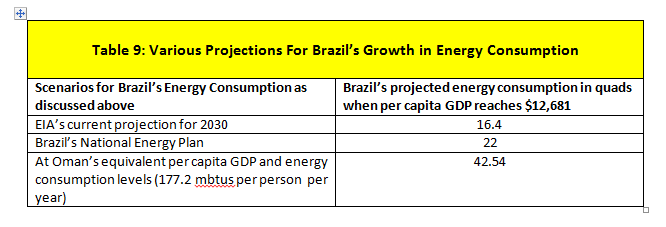
One of the fastest growing countries in the world is Brazil. It has a population of 191 million, and its energy consumption reached 10.6 quads in 2009. In 2006, energy consumption was 51.2 mbtus per capita. Brazil’s energy consumption grew at 3% per year between 1990 and 2010.Brazil’s Energy Planning Company EPE predicts that the country’s energy consumption will rise 3.7% annually, to 21.2 quads by 2030#. This is roughly in line with the Brazilian National Energy Plan, which forecasts a rise to 22 quads by that date.# Like Indonesia, Brazil has access to large supplies of energy, ranging from hydroelectric and ethanol at the greener end to vast oil deposits offshore. While India may face constraints on meeting the energy demand of its people, Brazil and Indonesia will not.
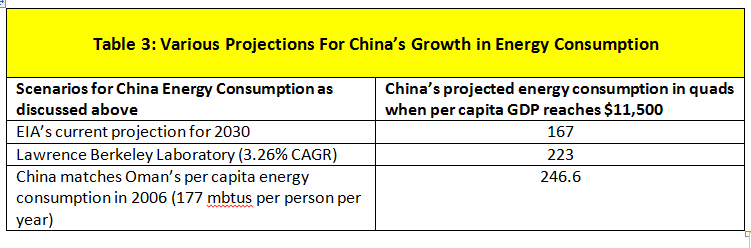
Pairing Brazil up with another developing country leads us back to Oman, which had, as noted above, per capita GDP of $11,528 (in 2005 dollars) in the year 2006, close to the per capita GDP projected for Brazil in 2030. Again, their per capita energy consumption that year was 177 mbtus. If Brazil’s population in 2030 does indeed reach 240 million and they do follow a pattern of consumption similar to Oman’s that would result in the much higher total of 42.54 quads.

Indonesia–smaller in scale but the same basic story

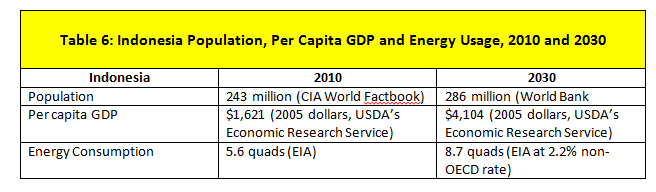
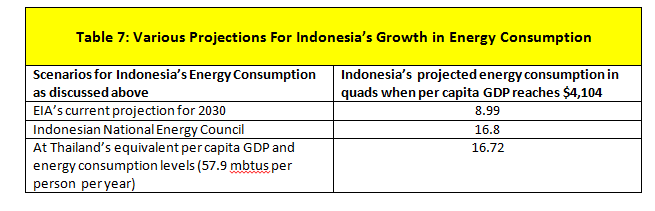
Like India, Indonesia has grown dramatically in recent decades, and like India it suffers only by comparison to the astonishing performance of China. Indonesia’s energy consumption grew 315% between 1980 and 2001 and has continued to grow since then, reaching a total of 5.6 quads in 2010.  If it maintained that level of growth through 2030, Indonesia would consume 17.64 quads, far more than the 8.7 quads the EIA projects. And the Indonesian National Energy Council predicts just that—a tripling of demand by 2030.

Indonesia’s situation is complicated by its situation as an energy exporter (it is the world’s largest exporter of coal, mostly to China), which means that existing stocks of energy supplies can be quickly converted to domestic use if required.
If Indonesia were to consume energy at the same per capita rate that Thailand does today when it reaches the same level of per capita GDP, it would be 16.72 quads, almost 60% more than the EIA projects.
However, if there is a short list of candidates for heroic performance in GDP growth among the developing countries, Indonesia must surely be on it. They are the world’s largest exporter of coal. The World Bank predicts growth for 2011 and 2012 at over 6%, and over the past decade the middle class has grown to 56% of the population, normally a sign of intensified energy consumption.

But it doesn’t end with China–see India

From an energy standpoint, India today can quite accurately be described as being where China was in 1980. In that year, China’s per capita energy consumption was 17.6 mbtus. In 2006, India’s was 15.9, having tripled from the 5.9 mbtus per capita it consumed in 1980. It desperately needs the same level of infrastructure build-out that China has been engaged in since Deng Xiao Peng declared a new era for China in 1978.Although India faces obstacles to growth, such as red tape, corruption, illiteracy and more, China did too. Although India’s per capita GDP doubled between 1998 and 2010, growing by 6.4% annually, the end total–$965 per capita—was a third that of China in the same year.

Projections through 2030 show India’s per capita GDP reaching $3,309, which is very close to Thailand’s per capita GDP today. And the EIA projects India’s energy consumption to reach 37 quads by that time, up from 20.5 quads in 2010, a CAGR of 2.39%.

However, a report titled Integrated Energy Policy, Report of Expert Planning Commission, predicts an annual increase in demand (not production—they are not certain India can provide for its energy needs) of between 5.2% and 6.1%. And this is an important point. China has the money to import energy. Some of the countries examined below are net exporters of energy and can divert energy supplies to domestic use as demand grows. This may not be as viable an option for India over the next two decades, creating a latent and unmet demand for energy that could surge if the economics of energy changes and leave hundreds of millions in an energy-starved situation.

Once again, GDP projections seem oddly disconnected from projections of energy consumption. In an extremely poor country with very large needs for infrastructure, housing, roads, and tens of millions of people eagerly waiting to buy cars to drive on those roads, while per capita GDP is projected to triple, per capita energy consumption is not even expected to double. The rate of growth is actually expected to slow down. India’s per capita energy consumption had a CAGR of 4% between 1980 and 2006. Any slow down in the growth of energy consumption will be happening as India’s population grows, overtaking China as the most populous country—in 2030.

To put it in perspective, the EIA projects that India, with a 2030 population of 1.52 billion and a per capita average GDP of $3,309, would use about the same amount of energy as did North Korea in 2007.

Friday start to the weekend

If we are burning 3,000 quads a year, there’s no use asking for justice. We will need to beg for

It Starts With China, Part the second

Let’s start with China and see how it works. In 2010 they consumed about 100 quads. The EIA projects that to rise to about 163 quads by 2030 (based on Figure 14 of their report showing China as consuming 23.7% of the 739 quads projected for the world). That’s a CAGR percentage of 2.47%, higher than their estimated growth rate for the rest of the world—1.4%. But is it high enough? As mentioned above, China’s energy consumption grew in 2010 by over 11%, and they look set to match that in 2011.

On a per capita basis, China’s energy consumption rose from 29 million British Thermal Units (mbtus) to 56.2 mbtus between 1996 and 2006, the latest date available for examination at the EIA website.

China’s per capita GDP is also set to grow, from its 2010 level of $2,802 (measured in 2005 U.S. dollars) to $10,718 in 2030. And during this period, China’s population is also projected to grow from its current 1,341,335,000 to 1,393,076,000.[1]

Starting With a Bad Example

As it happens, Hungary had a very similar per capita GDP—$10,676—in 2006. It’s certainly not absurd to conjecture that their energy consumption per capita might be quite close to China’s energy consumption when it reaches Hungary’s level, whenever that might be.

Hungary’s per capita energy consumption that year was 114.7 million btus. Applying that to China’s projected population yields a total of 159.7 quads—and that’s far less than the EIA projects.

However, Hungary has been a well-developed nation for a long time, with a stable population and needing little in the way of fresh housing stock or road building, and its population’s needs for appliances and cars are for replacement rather than new acquisitions by people joining the middle class for the first time. The same would hold broadly true for other European countries with similar incomes. Is there a better example?

Apples and Apples

I offer for consideration Oman—a developing country whose population and GDP has grown quickly in recent decades, if not as quickly as China’s, and which had a per capita GDP of $11,528 in 2006. Their per capita GDP doubled between 1980 and 2006, showing that development was vigorous and sustained, much like China’s.

Although much smaller than China, Oman has many parallels, even to the extent of using 5-year plans to steer their economic development. They have spent the last 40 years taking a development path that may not be radically different from what China will be doing in the next 25. Their population growth rate has been similar to what China expects. They have a long coastline, and maritime developments may be similar between the two. Their neighbors have been as touched and troubled as China’s. The CIA World Factbook lists many features in common. So Oman seems a very good comparison and far more appropriate than Hungary, primarily due to China’s continuing development of basic infrastructure and the number of people moving into the middle class over the next 20 years.

Oman had per capita energy consumption of 177.2 mbtus in 2006. If China’s per capita energy consumption were to reach the same level as Oman’s, it would total almost 247 quads. Whether China achieves that level of development in 2020, 2035 or 2050 is not significant here; when their per capita GDP approaches $11,500, their energy consumption may be near 250 quads. And as far more analysts make their living projecting financial trends than energy consumption (and have far more at stake), we would expect to see fairly accurate projections of when China would arrive at that point. If the EIA has their GDP figures right, it will be in 2035. The Price Waterhouse Coopers study mentioned earlier predicts that China’s GDP will grow more quickly (at a 6.3% CAGR). If that’s correct, it would happen in 2032.

I should look at one more point before expanding our examination. Is it realistic to think that China actually can provide adequate energy to achieve the increase demanded by their rising GDP? After all, we are talking about a rise from 56 mbtus per person to 177 mbtus in as short a period as 20 years.

It would be nice if history provided some examples of that happening in non-island countries (island countries frequently have wild swings in energy consumption for a variety of reasons, usually stemming from dramatic changes in the primary fuel sources used).

There are several—the states comprising the former Yugoslavia increased per capita energy consumption from 77 mbtus to 174 between 1980 and 2006, and Iceland went from 250 to 348. And a number of countries either doubled (Turkey, Hong Kong) or even tripled (Malaysia) per capita energy consumption during the same period. And, as luck would have it, Oman doubled its energy consumption and per capita GDP between 1980 and 2006. There is also one other country that tripled its energy consumption in that time frame—China went from 17.6 mbtus per capita in 1991 to 56.2 in 2006. So it can be done.

Few people think that China will grow at the same rate it achieved over the past few decades. Indeed, very few developing countries—actually, no developing countries—have an unbroken streak of continuous growth at high levels for the fifty year period that we’re referring to for China. But then, very few believed that China could maintain this high rate of growth over the past three decades…


[1] Population Division of the Department of Economic and Social Affairs of the United Nations Secretariat, World Population Prospects: The 2010 Revision, http://esa.un.org/unpd/wpp/index.htm

Second Day of Blogging–Plans and Hopes

Well, the first day of blogging about 21st Century Energy issues was really gratifying. About 250 of you showed up to say hi and see what this is–thanks.

It strikes me, however, that I might have a better chance of getting people to come back for a second visit if I lay out my plans and hopes for this little enterprise. This is something that could actually be shaped by your opinions, especially since it’s early days here. So feel free to let me know what would be useful and interesting to you in this regard.

Most of what is below this post is material I gathered together in hopes of submitting a paper to a journal or maybe a magazine as an article. I’ve got quite a bit of it left to post, so I’m going to look a lot busier than I actually am.

This part of the blog is intended to lay out my case–that we’re going to be using a lot more energy than people think. I will post tables and make my data available, and will be happy to discuss it, but I’m pretty sure the case I make is convincing (with some caveats where I will be specifically asking for your help). You’ll see an example of this about an hour after I post this, as I’m going to put up some figures about China as soon as I can.

That part of this weblog will be about 10 or 15 more posts at this stage. I will then start discussing with you what the consequences of this energy consumption are, what the world will look like when we’re consuming 3,000 quads every year. I expect elements of that discussion to be ongoing.

After we lay that out coherently (I say we because I hope to be working with you by that point, as opposed to simply laying out results of my research), I would like to start a discussion on alternatives–if we don’t like the way the future looks without real changes, what real changes can/should we make? I think at that point we’ll start having a lot of fun.

When I came back to San Francisco from Europe a couple of years ago (because I had just predicted a huge recession and thought I should act on my own beliefs), I resolved to choose between focusing on either health care issues or green technology for the next stage of my career. My previous focus on information and communications technologies had started to seem like looking at a plumbing trade magazine–I was sick of looking at routers and virtualization schemes and wanted something fresh.

I chose green technology after writing some industry research reports on both sectors. Both healthcare and green technology are geared towards prevention in the early part of the 21st Century. Healthcare has adopted the philosophical stance that making us stop smoking, drinking to excess, eating sugary foods, etc., is the most effective use of their limited resources for now. Green technology is oriented towards preventing consumption of fossil fuels and emitting CO2. Not that big a difference. But green technology is going to need innovation as much as changing behavior, while healthcare at this point seems to be just going after the way we live.

I’m really happy with my decision–for now. I think healthcare will get interesting again soon, after biotechnology, nanotechnology and robotics combine to redefine it. But those new sectors will affect green technology as well, and I have no doubt we will be discussing them here.

I am going to have a great time writing about all this. I hope that you’ll have a good time contributing to this effort and reading the results.

Again, welcome.

It Starts With China, part the first

Applying the 2.2% CAGR percentage for energy consumption that  the EIA assigned (in 2010) to the developing countries, they project that China will consume 162.7 quads in 2030. (Like the U.S., China consumed 100 quads in 2010.) I think that China will consume 246.6 quads in 2030. The difference—83.9 quads—is enough to change everyone’s vision of the future, if it is true. China has put forward an incredible plan for growth of its energy infrastructure. If it is based on the highly respected EIA projections, it may not be sufficient for their needs.

China’s annual growth in GDP from 2000 to 2010 averaged 9.9%. Their consumption of energy grew over the same period of time at a 9.57% compound annual growth rate (CAGR). If they merely maintain that for the next few years, the EIA’s projections are bound to fall short of their projected totals.

The EIA in fact is predicting an astonishing slowdown for China’s energy consumption over the next 25 years, something that would be as dramatic and profound as their recent growth. As they assume China’s economy will continue to grow at a robust rate, this should be explained. As yet, it has not been.

Evidence that the EIA’s underlying assumptions in energy projections should be challenged comes from widely reported statistics regarding China’s growth. China’s energy consumption grew 11.5% in 2010 alone, and they have marked out a path for growth that has energy consumption double between 2010 and 2020. Even if the EIA were broadly correct in predicting a fall-off in China’s energy consumption, missing the start of the decline renders their analysis useless for those charged with preparing the infrastructure needed for Chinese children—and ours.

Clearly, over-reliance on CAGR can be a trap, especially when dramatic change is part of a forecast. But for those charged with making plans for the medium term future, it is probably not nearly as important to precisely delineate the rate of change as it is to show broadly correct totals at various points on a continuum. Is there another way of projecting energy consumption that is more closely tied to reality? I think so.

The EIA also breaks energy consumption out on a per capita basis. This is quite useful, as with a bit of cross checking against future populations and projections for GDP, we can analyze, for example, China’s projected energy consumption in the future by comparing it to the energy consumption of a country that is at that level of development today. Energy figures used in this exercise come from Table E.1, World Primary Energy, International Energy Annual 2006, updated August 2009, with projected GDP figures coming from the U.S. Department of Agriculture’s Economic Research Service. Population figures come from a variety of sources, including the U.N. Population Division and national census offices. Information about the developing countries used as examples for comparison come from a wide variety of sources—including Wikipedia, the CIA World Factbook and Nationmaster.

Because the GDP projections used in this study do not extend beyond 2030, I now change our focus on growth of energy and GDP from 2035 to 2030. As almost all of the media coverage given the EIA’s projections use their headline 2035 end-dates, readers should note this.

By combining current data on per capita GDP and per capita energy consumption, we can perform an interesting comparison that may provide more accurate projections. More importantly, we are not obliged to provide a date certain for this growth. It doesn’t matter if their per capita GDP or energy consumption happens in 2020 or 2040—we can say that when their level of economic development reaches a certain stage, it is quite likely that their energy consumption will be near a value that we can estimate today.

Welcome to 3000Quads

Hi all.

I am concerned about the future of energy on this planet. It appears to me as though we are consciously ignoring some brutal realities about how much energy we are going to burn during this century, helped I think by some miscalculations by those charged with forecasting future consumption.

While we’re busy ignoring this, we have been having political battles about climate change, renewable energy, government subsidies and a lot of things related to energy. But because we’re starting off with bad numbers, a lot of the arguments, initiatives and conclusions don’t really mean very much.

I hope to show you how and why in this blog. I hope to see old friends (and even some ‘enemies’) show up here to discuss this. For those who remember me from discussions about climate change, this blog is not about that–or not very much. I may have a Sunday morning post on the subject just to keep my hand in and to give some people a chance to holler at me electronically.

But the bulk of this blog will revolve around one basic equation: The medium range UN forecast for population in 2075 is between 9.5 and 9.9 billion souls. Per capita income is estimated in the IPCC A1 SRES (a scenario of future growth used by many climate scientists and policy analysts) at about $66,500 in today’s money. That means most of the world will be richer than Americans are today. Assuming that there will still be a Bottom Billion amongst us (to our shame), if the 8.9 billion people who are actively part of this miraculous new world are consuming energy at the rate Americans are today (330 million btus per person per year), the world will consume 3,000 quads every year.

That is an amount of energy hard to visualize. Each quad represents the energy liberated from 37.8 million tons of coal, which would fit on a train that was 3,780 miles long.

If that energy need comes to pass and we are forced through inadequate planning to satisfy it with coal, we’re sunk. And yet we are using forecasts for the short and medium term future that assume a much lower rate of consumption.

This poses a problem for us, one I hope to discuss at length.

How I’ve been spending my evenings and weekends

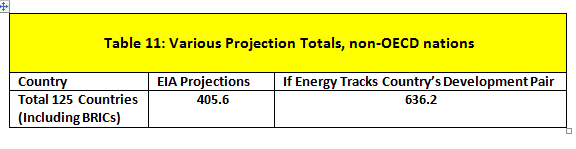
I looked at projected energy consumption totals for 125 countries that are not part of the OECD (except for Turkey, which I included in a fit of absent-mindedness) and have populations of over 1 million. In 2010, these 125 countries had a combined population of 5.66 billion, and a combined GDP of $18.6 trillion. By 2030, they will account for 6.96 billion people and their combined GDP is projected to be $36.84 trillion.

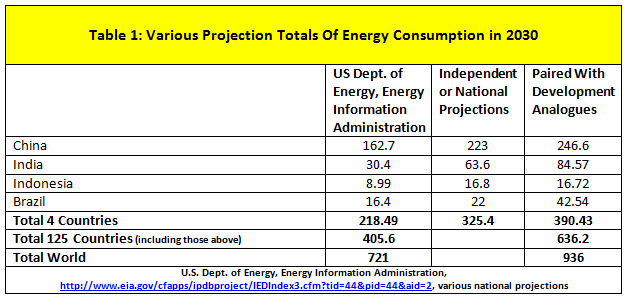
In 2006, these countries consumed 230.3 quads. The EIA projected (in 2010) that in 2030 these countries will consume 405.6 quads, a CAGR of 2.29%. My methodology indicates that these countries may well consume 636.2 quads, a CAGR of 4.15%.

That would permit the inference that global energy consumption will be closer to 936 quads than the EIA’s 2011 projection of 721 quads in 2030. The difference between the EIA’s estimate and ours—215.9 quads—is more than the current energy consumption of the U.S. and China combined. (I get to that total by assuming that EIA projections are accurate for the OECD at 278.7 quads and developing countries not included in my analysis, at 22 quads.)

What drives the difference? For 106 of the 125 countries, I paired these countries with other, similar, countries that had preceded them along the development path, and used historical figures of per capita energy consumption and per capita GDP to provide new figures. For the other 19 countries I was unable to find suitable pairings and took the EIA estimates instead.

The EIA calculated a 2.2% CAGR for the developing world in their 2010 report (and increased that to 2.3% for their 2011 update). My calculations, when including the countries where we accepted the EIA estimates, showed a CAGR of 4.15%. For the countries where I was able to find a paired country as an analogue, the CAGR was higher, at 5.07%.

The countries where I was unable to find an adequate ‘paired’ country had a 2006 energy consumption total of 33.9 quads and are projected by the 2010 EIA report to consume 58.3 quads. They included major energy producers such as Saudi Arabia, Venezuela and the United Arab Emirates, countries that are already consuming very large amounts of energy per capita. They also included high income states such as Taiwan and Singapore. In both cases I felt that I was unable to determine if further development would result in higher per capita energy consumption.

Thirteen of the countries I paired with examples yielded CAGR figures lower than the EIA. Almost all of those countries were Eastern or Central European states, including Russia. Their energy consumption in 2006 was 41.9 quads, and the EIA projected (in 2010) that their 2030 consumption would be 56.2 quads. My estimate for 2030 energy consumption for these countries was 50 quads.

The BRIC countries (Brazil, Russia, India and China) explain much, but by no means all of the discrepancy between the EIA’s projections and my own. According to my  projections, those four countries will account for 405.36 of the 636.2 quads from this set of developing countries. The EIA had projected (I infer, from the CAGR percentages applied to non-OECD nations) 243.2 quads from the BRICs.

Projections of Future Energy Consumption

Both the U.S. Energy Information Administration and the International Energy Agency project robust growth for energy consumption over the next 20 years. However, their definition of ‘robust’ pales alongside the real-world growth experienced by developing countries in the wake of globalization. The EIA projects energy consumption in the developing world to grow at 2.2% annually (a figure they raised to 2.3% in September of 2011). What I hope to show is that, although that may be true for parts of the non-OECD world (Central and Eastern Europe, parts of Latin America and some oil-rich countries that are already consuming as much as they ever will), the parts of the developing world that are also growing rapidly will see their energy consumption rise by 5% per year. At which point the conversation transcends energy and even economics. Energy growth at that pace in Asia and Africa then becomes a political issue. Several political issues, actually.

It’s unfair, of course. The vast energy consumption by the rich world is now taken for granted in this discussion, simply because it has stabilized. Both the EIA and the IEA believe that energy consumption by rich countries will grow by between 0.3% and 0.5% annually over the next 20 years. But that flat line is at the top of a vast quantity of coal, oil, natural gas, nuclear power, hydroelectric power and trace amounts of wind and solar that combine to bring us a life we take for granted, and which we will go to great lengths to protect. We don’t want your territory and we’re willing to pay for your oil and natural gas—but don’t even think about pulling the plug on it. The principal policy question then becomes: now that we’ve got ours, can the world permit the have-nots to get theirs?

The EIA periodically projects future energy consumption for the world, and splits out OECD and non-OECD countries for detailed reporting. In their report, International Energy Outlook 2010, the section World Energy Demand and Economic Outlook uses a compound annual growth rate (CAGR) of 1.4% per year for increased consumption of energy worldwide (Remember that in 2011 they increased their projected totals by 5%). Using a variety of different methods and other reported figures for GDP growth and energy consumption, I will try to show that this figure is too low and offer a range of possible values that may be more useful for planners, politicians and other stakeholders making decisions based on future energy consumption.

At the heart of my higher projection of energy use in the developing world is a very simple observation: Development is a path travelled by many countries, and different countries are at different stages of that journey. By comparing future energy consumption for one country in the developing world to energy consumption in countries that have been at a similar stage in the recent past, I hope to offer a new perspective that may serve to anchor estimates to realistic boundaries.

At this point I should point out that others have remarked on the discrepancy between projections and performance as far as energy use is concerned. However, most of the discussion has been about China. This is natural, as China has outperformed everybody’s expectations and is very hard to ignore. But the fact is that what is happening in China is also happening in Indonesia, the Philippines, Brazil and India, and many other places as well. China is not the only country using energy faster than expected.

Useful Reports

A lot of useful material is available on the internet. However, sites get moved or abandoned, so I am uploading reports here so they’ll always be available.

After I post this I will push it down to the bottom of the blog. I will update it frequently, and am adding links to the reports on the rather longish list of links on the right-hand side of this blog.

Suggestions are welcome for reports to include. If those suggestions come with lengths or attached reports, they will be much easier for me to deal with (hint, hint.)

Energy_and_Environment_in_China, May 2011

International Energy Outlook 2011, DOE EIA

International Energy Outlook 2010, DOE EIA

The World in 2050, Price Waterhouse Coopers

BP Energy Outlook 2030

Energy Consumption in the Developing World in 2030

What does it mean to the world if we discover that developing countries may use 57% more energy in 20 years than previously calculated? Or that the world as a whole may use 30% more energy in 2030 than we are planning for now?

This world of 7 billion people is in the process of preparing for the next 2 or even 3 billion humans who will join us on this planet over the course of this century. For most of us, that preparation consists of taking care of our families and preparing the next generation to do well in an uncertain environment. For those in public service, the preparation also includes making sure their city, region or country is doing more than just surviving the current crises and perennial problems.

For a very few, this preparation centers on predicting the future—how many of us will there be, how the economic condition of the world will enable or handicap their development, who will be advantaged or disadvantaged by changes in the human population and their effects on this world.

This story is about forecasting energy consumption, which forms the basis for both educated guesses and confident predictions about GDP, development and public health. Energy is one of the base assumptions for what we think will happen. Energy, along with fresh water, are limiting factors—if we have enough of them, we can make other plans. Without adequate supplies, planning will be based on shifting sands.

Despite this, there really aren’t that many organizations making careful forecasts of energy consumption in the future, especially compared to the number of organizations that try to estimate economic growth. It is true that there are many companies, think tanks and government departments that are very interested in how much of what type of fuel will be available, where they can find it and how much it will cost. But once it’s out of the ground or into the fuel tanks and electricity grids of the world, their interest declines sharply. Supply is very important to these people. Consumption, not so much.

One exception to this is the U.S. Department of Energy’s Energy Information Administration. It was formed in 1977 as a response to the oil supply shock of 1973. It is the U.S.’s go-to source for data and information about energy use worldwide, as well as America. About 400 people work for the EIA and it has an annual budget close to $100 million. Perhaps because they are independent of political influence, they have a pretty good track record. They are highly respected and deservedly so.

(The other major provider of statistical information about energy use is the International Energy Agency, an inter-governmental organization set up in 1974 for pretty much the same reason as the EIA—to provide information to better deal with situations like the oil crisis that had just concluded.  But because they were formed as a policy tool to deal with oil supply disruptions, their numbers (which are not as easy to access as their American counterpart’s) are not always considered impartial and are not as widely used. For this article I focus on the U.S. Department of Energy’s Energy Information Administration’s figures.)

The end result of what both organizations do is hugely important to planners for the future. Those who are deciding where and how many power plants, dams, roads and wind turbines to build, how many roads, planes, pipelines and ships will be needed and for those estimating how to budget for provision of energy to tomorrow’s populations. Two million people download data from the EIA’s website every month.

I am one of them. I’ve been an energy analyst in the past, one of those who write incredibly long reports about things like ‘The Global Market for Energy Efficiency 2009-2014’ (sadly, an actual title). I now work as a market researcher for a solar power company. And this story is about how I have come to believe that the DOE’s EIA may be wrong about something very important—their estimates of how much energy the developing world will consume over the next 20 years.

The Energy Information Administration, an organization I greatly respect and whose numbers I use almost daily, projects that the world will use about 721 quadrillion BTUs in 2030, a staggering amount of energy and a large increase over the 500 ‘quads’ the world consumed in 2010. But I think the world will use closer to 936 quads in 2030, primarily because the developing world will develop faster than estimated by the EIA.

British Thermal Units (BTUs)

Sit in a darkened room and light a wooden match. Watch it burn. You may not feel the heat. The light it emits may not create more than a glow around your hand. You may or may not smell the slight sulphur tang, and the trail of smoke will surely be tiny. When it burns out, you have consumed a unit of energy called a British Thermal Unit, or a BTU.

Technically, a btu is the amount of energy required to heat a pint of water from 39 to 40 degrees Fahrenheit. But a wooden match burning in a darkened room provides a more concrete image.

Much of the discussion here on Quads will be about how many BTUs per capita people consume in different countries. The U.S. consumed 330 million BTUs per person in 2008, down from a peak of 346 mbtus per capita in 1989, but still an impressive figure.

By contrast, Denmark consumed 152 mbtus per person in 2008, also down from their peak of 186 mbtus in 1996. And China, despite being the largest consumer of energy in the world, spreads that consumption across a larger population–their per capita consumption has grown steadily for decades but only amounted to 65 mbtus per person in 2008.

As you will no doubt tire of reading if you spend much time on this weblog, one of the central questions of this century will be how China develops–if they aim for an American level of energy consumption, they will consume 459 quads per year when they have developed to America’s current levels. If they instead target a Danish lifestyle (which in many ways is materially better than that of America’s), it will be 211.

Caveats and Sources

Caveats

Although I think this research is persuasive, the scope of the topic is wide enough for alternative assumptions, calculations and conclusions. Because the EIA’s reports are widely used and often cited as among the most credible forecasts, the topic is important enough to take seriously, and if this theory is correct, it would be of some use to find this out now, rather than later.

I should also note that although I call the figures here EIA projections, I did not find EIA projections at the country level. I used their global CAGR% for non-OECD countries. (I used the 2.2% CAGR from their 2010 report. The EIA raised that to 2.3% in September of 2011, when they also raised their forecast of global energy consumption to 721 quads in 2030.)

Perhaps most importantly, this study is comparing figures and projections from separate databases, something that should give readers pause. Although I think that one of the strengths of this study is that it actually uses fewer data sources and more historical figures than competing estimates, it remains true that differences in data collection procedures and analysis may have contributed to incorrect findings in this study.

As I mention elsewhere, I consider this the start of a conversation, not the conclusion. It is for this reason that I have tried to maintain a casual—conversational—tone while writing this, for which I ask the indulgence of academics more used to a different style of presentation.

Sources

Sources used throughout this are:

  • Projected Population and Growth Rates in Population for Baseline Countries/Regions  2000-2030, Updated: July 20, 2010 based on June 2010 Census Bureau Update, Source: U.S. Census Bureau, International Data Base (http://www.census.gov/ipc/www/idb/)  organized into ERS/USDA Baseline countries and regions, curated by USDA ERS
  • World Per Capita Energy Consumption 1980-2006, International Energy Annual, 2006, U.S. DOE EIA, Table E.1c found at http://www.eia.gov/iea/wecbtu.html
  •  Real Projected Gross Domestic Product (GDP) and Growth Rates of GDP for Baseline Countries/Regions (in billions of 2005 dollars) 2000-2030, Updated: 12/22/10 Source: World Bank World Development Indicators, International Financial Statistics of the IMF, HIS Global Insight, and Oxford Economic Forecasting, as well as estimated and projected values  developed by the Economic Research Service all converted to a 2005 base year. Curated by USDA ERS
  •  EIA Total Primary Energy Consumption, 2006, http://www.eia.gov/cfapps/ipdbproject/IEDIndex3.cfm?tid=44&pid=44&aid=2
  • EIA projected growth rates for primary energy consumption calculated at 2.2% CAGR

Quads–An Introduction

Picture a train car, filled with anthracite coal. Let’s be picturesque and go back to the 1970s, when smaller and weaker train cars held about 100 tons of coal. Back then, they typically formed trainsets of 100 cars, each holding 100 tons of coal, for 10,000 tons in total. One of the longest trains in history was on the Sishen-Saldanha Railroad in South Africa, operated in August of 1989. It used 7 diesels and 9 50-kV electrics to move 660 cars, a tank car, and a caboose. It traveled 535 miles in 22 hours and 40 minutes. It took a whopping 4.3 miles to stop the train. The train was over 6 miles long.

Now, picture a longer train. Imagine the longest train ever conceived of—one with 378,000 cars loaded with anthracite coal. Although coal cars vary in length, you can often estimate about 100 cars to a mile. So picture a train 3,780 miles long—the distance from Dublin to Kandahar, or from Albuquerque New Mexico to Anchorage Alaska. It is 1,500 miles longer than the tar sands oil pipeline from Alberta to Texas that is being so vigorously disputed as I write this in January of 2012.

If you burn all the coal in that train—each of the 100 tons in each of the 378,000 cars—you will have consumed 1 quadrillion BTUs. And we give the energy liberated from that incredible quantity of coal a cute little name. We call it a ‘quad.’

In 2010, the world consumed energy equivalent to the coal loaded onto 500 of those trains. The world as a whole consumed 500 quads. And despite progress in getting power from nuclear, hydro, wind and solar, in actual fact 143 of those imaginary trains filled with coal were not imaginary—they actually were filled with coal.

Comment policy and moderation

Hi, all. Just a quick note about moderation and commenting.

A blog without comments is like a peanut without butter. Or something like that. Anyhow, of course I welcome your comments. Because my employer is associated with this blog, and because I have fond hopes that some of the information here will be useful in the world of education, I ask that we keep this family friendly–no profanity please. I will delete even the most elegant post if it has profanity in it.

I will not censor commenters, nor will I edit them or comment within them. I will not delay them. I will delete comments if a thread starts turning into a flame war, or if someone is particularly abusive (my judgement). But I’m pretty liberal about that and I do expect a vigorous exchange about some of the topics here.