Energy As A Constraint To Growth

In 1972, the publication of the book The Limits to Growth framed the agenda for discussion of the future of the human race for the next 40 years. The book’s focus on population, pollution, non-renewable resources, food and industrial output became the basic parameters to measure.

Forty years later and we can all see that they got their predictions wrong, a point made by Bjorn Lomborg recently in an essay in Foreign Affairs, where he echoes Julian Simon’s thesis that human innovation renders those five horseman of the Apocalypse irrelevant.

Because I’m an optimistic believer in the human mind and the technology it creates, Simon’s thesis and Lomborg’s repetition of it resonate with me (although Jerry Pournelle did it better in 1984 in my opinion, with his book A Step Further Out). I really do believe that we are entering a new age full of potential and the promise of a good life, rather than stumbling gasping through the end of the last good years of humanity.

But because the predictions of doom in The Limits to Growth were being proven wrong, it only recently occurred to me that the book was measuring the wrong things. Okay, so it took me 40 years to figure it out. In my defense I will note that most still haven’t figured it out…

If the sum quantity of resources is not the issue, what is? Obviously it is access to those resources.

I’m hugely pleased that the Green Revolution and now, GMOs have made it possible for us to produce more crops than needed to feed everyone on this planet and even everyone who will be on this planet when population reaches 9.4 billion. But people are starving today with resources cruelly just out of reach or being consumed by pests or rotting on its way to market.

The fact that The Great Reforestation is taking place across much of the world is wonderful–but the fact is that where it is needed most it has yet to occur.

While population growth has been tamed in country after country, in the poorest parts of the world that extra pair of hands is still a family’s best insurance policy against an uncertain future.

This weblog is about energy, which isn’t even part of the grand metrics by which The Limits To Growth measured us and found us wanting. They counted oil and natural gas, of course, and incorrectly thought we would run out (and started a cottage industry of people betting on Peak Oil). But they didn’t look at energy.

We have the capability to provide enough energy for all the people on this planet, should we choose to do so. We could always have done it with coal. We could have done it with nuclear power, as the French have proven. We could do it today with a modern portfolio that includes natural gas, solar, wind and fossil fuels and nuclear power. I don’t know why we choose not to do so.

Because I would argue that if you give people energy, you really don’t need to give them much of anything else (although I’m not arguing for the cessation of food, medical or educational assistance). If the poor have light, the children (and equally as important, the women) will study and learn, and family sizes will decrease and incomes will increase. If the village has refrigeration, vaccines will keep and food will be stored and health will improve dramatically. If the region has power, industry will develop and so too will infrastructure.
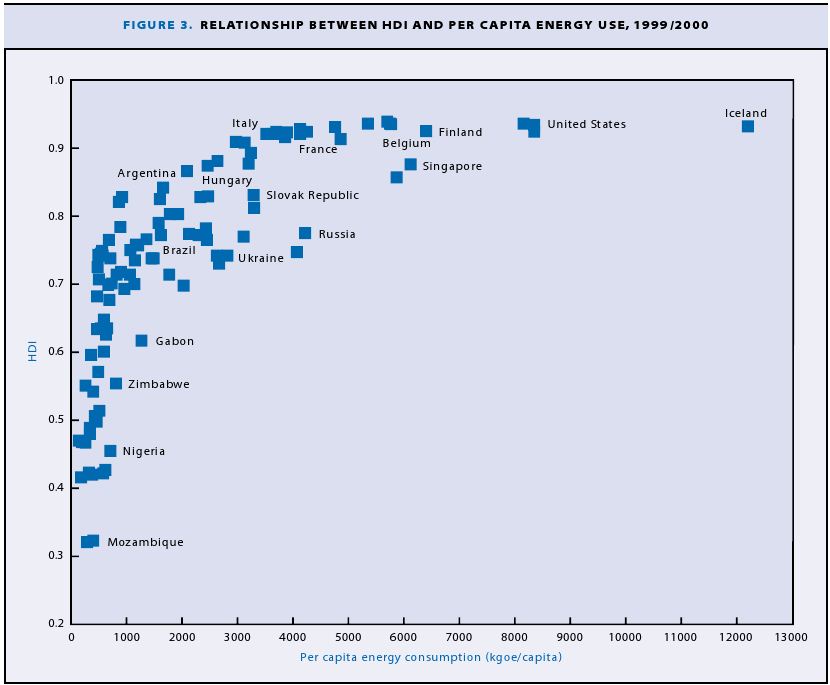
It appears to me that energy is the key constraint to human development. Or at least it is the last remaining hurdle to successful development. The dilemma is simple. Energy availability is the real measure of development. And it is one that really doesn’t get measured. The world needs energy to get wealthy. And the world spends its wealth on energy.

The proof is watching what developing countries have done as their incomes expanded. What do they spend their new found treasure on? Washing machines. Refrigerators. Automobiles or motorcycles. Radios and televisions. Air conditioning–Kuwait uses 66% of all the energy it consumes on air conditioning…

Energy is as important to human development as air, and just as taken for granted. People don’t go out and spend their first paycheck on energy. They spend it on the appliance that changes their life. Because they can plug it in and turn it on.

We measure the symptoms of energy availability and its lack. But energy itself is an afterthought, not even included in the sober analyses and high level prognostications of the great and mighty.

But if we fixed the issue of access to energy, we could probably pack up our do-gooder fix-it kits and head on home. Because the people we’ve been trying to help could handle the rest on their own.
Global Warming, the DOE and Energy Consumption

Neither this blog nor this post are  about climate change and global warming. However, as the DOE’s recent projections for energy consumption through 2035 make some implicit assumptions about population shifts and the use of energy for space cooling, I have been wondering about what those assumptions are, how they were formed and what they imply.

The DOE has a raft of documents dealing with global warming and/or climate change. They analyze legislation and regulations and their potential impacts on fuel supplies and the mix of energy available. They calculate past, present and projected CO2 emissions. They study energy efficiency. In fact, they have 13,3o0 returns for the search term climate change.

However, I was unable to find one document dealing with their thinking on how climate change might affect energy consumption. The implicit assumption in what I’ve read is that governments state and federal will use pricing mechanisms to affect the cost to the consumer of energy and hope to control consumption. They seem to feel that energy efficiency can be pushed on to consumers, even at higher prices. But I see no signs of analysis of what we the people will do in response to global warming in any area of our lives, nor how that might affect energy consumption.

This was forcibly brought to my attention when analyzing their projections of residential energy consumption through 2035 in their Annual Energy Outlook 2012, which comes with projections through 2035.

In their report, the DOE estimates residential energy consumption will grow very slowly, at 0.2% annually, despite much higher growth in population (1% annually), household formation (.93% annually) and GDP (which doubles over the projection period).

There are two key assumptions that drive this low ball estimate of energy consumption in homes and apartments–the first being heroic improvements in energy efficiency, which I find surreal. (Energy efficiency gets harder the longer you do it, because you naturally do the easy stuff first. And the DOE estimates that energy efficiency will improve twice as fast in the next 25 years as it did between 1980 and 2005.)

More troubling, the second assumption is that people will move to “warmer and drier climates” which will reduce the need for space heating in homes. This would be an extension of the Snowbird effect, where retirees in colder climes relocate to sunnier places, something that was very real and pronounced over the past 60 years.

Never mind that they don’t show an increase in energy used for space cooling. What I want to know is, if global climate change is projected to produce killing heat and megadroughts in large parts of the U.S., why would people move there?

If people don’t move there in large numbers, the DOE’s projections will suffer. If people instead are forced by global warming to leave the affected areas, the DOE’s projections will fall apart. And yet there is no discussion of this in the report itself, nor in the recently released Assumptions to the report.

I have doubts about the dire predictions of global warming. I guess that’s my right as an individual citizen. But should a department of the U.S. Federal Government just ignore the work done by the EPA, NASA, the NOAA, the, umm, other parts of the Department of Energy… in preparing the core data planners everywhere will use to decide how energy will best meet our needs?

The concept of joined-up government is one I learned while living in the UK. It isn’t perfectly executed there. But it doesn’t seem to have made it across the pond at all.

U.S. Commercial Energy Consumption Through 2035

Here we continue our look at the DOE EIA’s projections of U.S. energy consumption through 2035. In this post we look at what they foresee happening in the commercial sector (essentially composed of offices and stores).

Almost immediately we encounter issues that can leave us scratching our collective heads, especially when we compare what is written about this sector with what we have discussed earlier regarding residential energy consumption.

According to the Department of Energy, energy consumption in the commercial sector will increase from 18.3 quads in 2011 to 21.5 quads in 2035, a CAGR percentage of 0.67.

The DOE estimates growth of 26.9% (0.93% annually) in commercial floor space over the period covered by this report, very similar to what they project for new household formation (25%). And they estimate even greater gains in energy efficiency in offices than in residences (7% per square foot, compared to 6% overall in residences). And yet, where they anticipate residential energy consumption to decline slightly, they predict commercial energy consumption to increase 18% over all by 2035. I’m not sure both estimates can be accurate…

They identify the core components of energy consumption in the commercial sector as space heating, ventilation, air conditioning, water heating, lighting, cooking, and refrigeration, which are pretty much the same as residential, and they attribute 60% of commercial energy consumption to these items. And they predict that that will fall to 53% over the next 25 years thanks to improvements in energy efficiency. In a case study (one of several focus issues that leads off their report) they identify the sources of the improvements they hope to see in energy efficiency as high-efficiency variable air volume ventilation systems, LED lighting, ground-source heat pumps, high-efficiency rooftop heat pumps, centrifugal chillers, and solar water heaters. However, they caveat this list by saying the obvious, that “those technologies are relatively costly, however, and thus unlikely to gain wide adoption in commercial applications without improved economics.”

Just as an example, they predict space cooling to decrease from 1.83 quads in 2011 to 1.60 quads in 2011. This, after space cooling just increased from 1.5 quads to that 1.83 number in 2 years. Once again, we ponder the dilemma–they believe that population shifts to warmer climes. But space cooling decreases…

The bottom line for their report seems to be that the 26.9% increase in new commercial buildings will consist of highly energy efficient structures taking thorough advantage of all available methods for reducing energy consumption. And maybe that will happen. Maybe builders across the country will ignore the economic difficulties facing it and use more expensive technology in a sector that faces far fewer regulatory constraints than industrial construction. Maybe the demographic trend that is sending more people back to the city will somehow lead to less expensive (????) commercial buildings. Maybe the demographic trend they postulate regarding residential energy use, the large scale movement of people to warmer climates, will lead somehow to lower energy consumption, although air conditioning would seem to negate whatever gains are made due to lower space heating…

Certainly I hope they’re right–that a 25% increase in population, a doubling of GDP and a 26.9% in new commercial floor space will only result in an 18% increase in energy consumption. But as with residential and transportation, it means everything has to go right–that we will double the rate by which we improved energy efficiency over the past two decades.

Here’s hoping.

Transportation Fuel Consumption Through 2035

More than a quarter (26 of 98 quads) of our energy consumption in 2011 was for transportation. The vast majority (64%) was for light duty vehicles–the family cars. This was followed by heavy duty vehicles (19%), air travel (10%), marine (5%) and rail (2%).

The U.S. Department of Energy’s Energy Information Administration predicts that energy consumption for transportation will grow at an annual rate of 0.1%, from 27.6 quads to 28.6 quads. This is revised downward from their 2011 estimate of growth at 0.5% to 32 quads in 2035.

In my previous post I charted their assumptions for macro-economic drivers (population increase at 1% annually, GDP growth at 2.5% annually, 25% growth in household formation), all of which made me skeptical that the EIA could be ultimately correct about residential energy use. All of those factors apply to transportation as well.

But there are other factors at play in the transportation sector. Legislation mandates improvements in gas mileage for light duty vehicles (LDV), which the EIA duly notes. They forecast energy consumption for LDVs to drop 3.2% overall between now and 2035. But the better mileage is only one of the reasons they cite. The other is that they believe personal travel demand will rise more slowly than in recent decades.

I can easily believe that fuel efficiency will climb to comply with the law. There’s plenty of room for improvements and the government’s attempt to shift to measuring greenhouse gas emissions as opposed to fuel consumption may accelerate that trend. But the EIA offers absolutely no evidence to indicate why they think personal travel will grow more slowly. Population change doesn’t slow down. GDP grows at 2.5% per year. In fact, in their section on residential energy consumption they postulate something like a mass migration to warmer and drier climates as a reason why space heating will decline. But such a migration in the past has entailed vigorous personal travel as people return to visit the families they left behind.

Perhaps more significantly, with more domestic oil being brought to the surface, with growing numbers of cars converting to natural gas or hybrid- and all-electric  status, someone is going to have to explain to me why prices at the pump will not become less of a factor in determining the utilization of vehicles. This is in sharp contrast to the EIA’s forecasts, which see a real increase in prices of 48% for gas between now and 2035. And even though they predict personal incomes will rise by 81% during the same time frame, $5 a gallon gas would probably moderate driving just a bit. But is that realistic?

The EIA provides the following estimates for light duty vehicles for now and 2035:

  • The number of licensed drivers increases from 210 to 269 million
  • The miles driven per driver per year increases from 12,700 to 13,300
  • But total fuel consumption drops from 16.7 quads to 16.1 quads because…
  • Vehicle efficiency in miles per gallon improves 38%, from 20.4 mpg to 28.2

The EIA’s figures strongly suggest that Americans will drive their light vehicles almost 1 trillion more miles in 2035 and use 3% less gas.

I don’t see it happening that way. I think they were thinking more clearly in their 2011 estimates.

What Doesn’t Add up in the DOE’s Energy Consumption Estimates?

On April 26, 2012, the acting administrator of the DOE’s Energy Information Administration, Howard Gruenspecht, gave a presentation to the Institute of Clean Air Companies.

Working from reference case for the U.S. Annual Energy Outlook for 2012, Mr. Gruenspecht highlighted some of the very issues that have me asking questions about the feasibility of achieving the Reference Case’s forecasts, which show American energy consumption rising at a very low rate of 0.3% CAGR through 2035–from 98 quads last year to 107 quads in 2035.

Both the slides from his presentation and the AEO2012 report rely heavily on increases in energy efficiency to overcome other trends that would seem to drive energy consumption higher.

In particular, as I noted previously, the DOE forecasts growth in residential consumption of electricity at 0.2% annually, despite steady growth in population, the number of households and income. Specifically,

  • The EIA expects the number of households to grow at 1% annually, from 117 million households today to 145.6 million households in 2035 (and each of those households will have a refrigerator, TV, washing machine…)
  • The average square footage of these households will rise by 100 square feet, from 1660 to 1760 (with all the air in those larger houses to heat and cool each winter and summer…)
  • In the AEO2012 Reference case, residential sector energy intensity, defined as average energy use per household per year, declines by 19.8 percent, to 81.9 million Btu per year in 2035 (in 2011, elivered energy consumption was 101 million Btu’s per household)

In regards to the last bullet point, U.S. residential energy intensity declined only 9% from 1980 to 2005–and the easy wins for energy efficiency come first. It gets tougher after the low hanging fruit have been picked.

What drives their calculation of more efficient energy usage is first,  space heating, the largest factor in residential energy consumption, which they postulate will decline by 0.4% annually and second, higher prices–they forecast a 1% annual increase in real prices for energy…

Aside from energy efficiency, they cite one other factor contributing to lower use of energy in the residential sector: “Population shifts to warmer and drier climates also contribute to a reduction in demand for space heating.” (What will they do if global warming means more air conditioning… and everybody makes enough money to be able to afford it?)

From their report: “Real GDP grows by an average of 2.6 percent per year from 2010 to 2035 in the AEO2012 Reference case, 0.1 percent per year lower than in the AEO2011 Reference case. The nation’s population, labor force, and productivity grow at annual rates of 0.9 percent, 0.7 percent, and 1.9 percent, respectively, from 2010 to 2035.”

The population will grow by 25% over the period covered by this report, from 311 million to 389 million. The country’s GDP will almost double, to $24 trillion in 2005 dollars.

More houses. More people. Larger houses. More income to spend on energy bills. It’s going to take a heckuvalot of energy efficiency to counter that.

I don’t see it. Next we’ll look at transportation.


Well, that’s not cool

The Energy Information Administration of the Department of Energy has this announcement on its website:

No International Energy Outlook will be released in 2012. The next edition of the report is scheduled for release in April 2013

Guess I’ll have to do my own.

How The DOE Thinks We’ll Save Energy Through 2035

In my last post I noted that the DOE thinks growth in energy consumption will average 0.3%  per year, despite a 25% growth in population and an almost doubling of GDP over the same period. I’m referring, of course, to the DOE’s Annual Energy Outlook 2012 With Projections to 2035.

It would take heroic performance and restraint–I called it winning the Green Trifecta previously. Let’s look at how the DOE thinks we’re going to get there.

In the Executive Summary of the report, they speak broadly–“The U.S. does not return to the levels of energy demand growth experienced in the 20 years prior to the 2008-2009 recession, because of more moderate projected economic growth and population growth, coupled with increasing levels of energy efficiency. For some end uses, current Federal and State energy equirements and incentives play a continuing role in requiring more efficient technologies.”

Later I imagine I will have a bone to pick with them regarding both their estimates of GDP growth and the impact of population growth. But let’s park those for the moment and look at more specific mechanisms for moderating energy consumption.

Among them:

  • New greenhouse gas (GHG) emissions and fuel consumption standards for medium- and heavy-duty engines and vehicles, published by the U.S. Environmental Protection Agency (EPA) and the National Highway Transportation Safety Administration (NHTSA) in September 2011.
  • California Assembly Bill 32 (AB 32), the Global Warming Solutions Act of 2006, authorized the CARB to set California’s GHG reduction goals for 2020 and establish a comprehensive, multi-year program to reduce GHG emissions in California. As one of the major initiatives for AB 32, CARB designed a cap-and-trade program that started on January 1, 2012, with the enforceable compliance obligations beginning in 2013.
  • After 2020, growth in manufacturing output slows due to increased foreign competition, slower expansion of domestic production capacity, and higher energy prices.
  • Even as standards for building shells and energy efficiency are being tightened in the commercial sector, the growth rate for commercial energy use, at 0.7 percent per year, is the highest among the end-use sectors, propelled by 1.0 percent average annual growth in commercial floorspace.
  • In the residential sector, increased efficiency reduces energy use for space heating, lighting, and clothes washers and dryers.
  • In the transportation sector, light-duty vehicle (LDV) energy consumption declines after 2012 to 14.7 quadrillion Btu in 2023 (the lowest point since 1998) before increasing through 2035, when it is still 4 percent below the 2010 level.

They have a lot more about residential consumption of energy:

  • Total delivered energy use in the residential sector remains relatively constant from 2010 to 2035, but a 27.5-percent growth in the number of households reduces the average energy intensity of each household. Most residential end-use services become less energy-intensive, with space heating accounting for more than one-half of the decrease. Population shifts to warmer and drier climates also contribute to a reduction in demand for space heating.
  • Portions of the Federal lighting standards outlined in EISA 2007 went into effect on January 1, 2012. Over the next two years, general-service lamps that provide 310 to 2,600 lumens of light are required to consume about 30 percent less energy than typical incandescent bulbs. High-performance incandescent, compact fluorescent, and light-emitting diode (LED) lamps continue to replace low-efficacy incandescent lamps. In 2035, delivered energy for lighting per household in the Reference case is 827 kilowatthours per household lower, or 47 percent below the 2010 level.

We’ll go into all this in detail over the next few posts. There’s more about all of the sectors and I’ll probably spend at least one post on each sector.

My preliminary take-away from all this is that if you postulated any one of these to me I would say it’s well within the realm of possibility. However, if anyone were to tell me that all of these were sure enough bets to make policy decisions on, I would start to shake my head in dismay. That’s more than a Green Trifecta. It would be like winning the lottery on successive days.

One thing that is not explicit in the report but seems to really drive a lot of their thinking–a core assumption seems to be that energy will get more expensive–expensive enough to justify the wholesale changes they are predicting.

They do project a gradual climb in oil prices to $150 per barrel by 2035. (They have a High Oil Price Scenario showing prices reaching $200/bbl and a Low Oil Price Scenario with prices plunging to around $65 and staying there.) But this is odd, as they foresee the coming to market of significant quantities of domestic energy, both oil and gas, as well as the continued successful penetration of some renewables. This would normally put downward pressure on prices. I guess a Republican point of view would suspiciously assert that government will artificially raise energy prices. I wonder if there are other explanations…

U.S. Energy Consumption in 2035: Analyzing the DOE’s Projections

Before we try and do any serious thinking (and while my brain still is recharging after my recent project), let’s look through the Department of Energy’s report, Annual Energy Outlook 2012 with Projections to 2035 and get the numbers racked up.

Let’s start with macroeconomic figures. The DOE’s Reference Case (the center projection on which they base their analyses, by and large) shows the U.S. GDP growing from $13.318 trillion in 2011 to $24.539 trillion in 2035, a growth rate of 2.5% (those are all in 2005 dollars, btw). As they forecast consumption growing at a slower rate–2.3%–they apparently don’t think we’re going to go out and spend all that extra money.

Well, they’re certainly not going overboard with enthusiasm about our future. A 2.5% growth rate is low. It’s not out of line with what others predict about our future, mind you. But for example, 2010 had growth of 3% and I don’t think anybody was thinking we were utilizing all our economic capacity that year. In fact, U.S. GDP was higher than 2.5% in 5 of the last 10 years, according to the U.S. Department of Commerce’s Bureau of Economic Analysis.

And I’m starting to notice some things that bother me. The next thing I want to check is population, which is normally the most significant driver of energy usage. But although they say on page 25 that they project U.S. population to increase by 25% over the period covered by their report, they don’t give a total or the reference number that the 25% is added to. And I see that happening throughout the report–percentages without base numbers. They didn’t do that in prior years. This troubles me.

But okay–the U.S. Census Bureau’s mid-year estimate for 2011 was 311,591,917 and a 25% increase would be 77,897,979 for a total of 389,381,896. That’s a growth rate of 0.93%.

So when I get back into thinking mode, my first question is likely to be, if you think population is going to grow by 0.93% annually and you think that GDP is going to grow by 2.5% annually, is it realistic to project (as the report does) that energy will grow by 0.3% annually?

Look at the above numbers. Income increases from $13 trillion to $24 trillion. Population increases from 311 million to 389 million. And the DOE is telling us that energy consumption will grow from 98 quads to 107 quads.

That’s a whole lot of non-consuming going on.

Well, I’m sure I will see the light after some July rest and relaxation.


The DOE’s Daring Assumptions

Well, I’m out of the analyst’s cave. I have sent off the report I was working on, looked out the window and noticed it was July. How did that happen?

I also noticed that the U.S. Department of Energy has released their Annual Energy Outlook for 2012 with projections for 2035.

And I’m numbered out. I have photovoltaic CAGR percentages on the brain and the DOE’s report looks like a soup of numbers right now.  I need a bit of R&R.

However… I did notice… “Overall U.S. energy consumption grows at an average annual rate of 0.3 percent from 2010 through 2035 in the AEO2012 Reference case.”  And… “Energy consumption per capita declines by an average of 0.6 percent per year from 2010 to 2035.” And…”Energy consumption per capita declines by an average of 0.6 percent per year from 2010 to 2035 (Figure 1). The energy intensity of the U.S. economy, measured as primary energy use in British thermal units (Btu) per dollar of gross domestic product (GDP) in 2005 dollars, declines by an average of 2.1 percent per year from 2010 to 2035.”

When the appropriate part of my brain starts working again I will pick those apart a bit. For now, though, I’ll just note that they are essentially saying that the U.S. of A. will hit the Green Trifecta.

They are saying that the past ten years of energy consumption are a picture of what will happen over the next 25:

They are predicting that the dip in per capita energy use experienced during this recession will be continued no matter what happens to the economy for the next 25 years:

And the same chart shows an acceleration of energy efficiency, as we get more bucks for our bang, almost literally.

We’ll look closely at how they expect to get there, but expect to spend some time evaluating this quote: “In the AEO2012 Reference case, residential sector energy intensity, defined as average energy use per household per year, declines by 19.8 percent, to 81.9 million Btu per year in 2035 (Figure 74). Total delivered energy use in the residential sector remains relatively constant from 2010 to 2035, but a 27.5-percent growth in the number of households reduces the average energy intensity of each household. Most residential end-use services become less energy-intensive, with space heating accounting for more than one-half of the decrease. Population shifts to warmer and drier climates also contribute to a reduction in demand for space heating.”

It’s good to be back! Wow–it’s summer!

U.S. Homes Using Less Energy

You used to be able to predict how much energy a home would use, just based on how big it was. Either heating or cooling took more energy to change the temperature of a larger space.

We can’t do that anymore. Homes increased in size from 1,800 square feet when built in the 1980s to 2,465 square feet when built in the 2000s (remember when we built houses?)

Not only did they get bigger, but the ceilings got higher as well, meaning there was more air to condition. Just 17% of homes built in the 1970s had ceilings higher than 8 feet, but 52% of homes built in the past decade did.

So what happened to energy consumption? It dropped–dramatically, from 127 million BTUs per household annually to 90 million.

It’s not because everybody moved back in with mom and dad, either. The largest segment of households had 2 people only.

What’s happening is that energy consumed per square foot has dropped as house  size has grown. Small and older houses use a lot of energy–sometimes three times as much per square foot as larger, more modern houses.

Energy efficiency is being incorporated into new buildings and it is working. We’ve grown from 80 million houses to 117 million and are using the same amount of energy. We’ve grown from 226.5 million souls in 1980 to 308 million in 2009–and it isn’t taking any more energy to house us.

Good for us.

Signs of Increased Energy Consumption

Sorry about the non-existent posting for the past couple of weeks. I’m working on a report on the market for photovoltaics for the next five years and am approaching deadline.

In case you’re not a faithful reader of this blog, here’s a brief recap:

  • I contend that the developing world will be using more energy than is projected by the DOE’s Energy Information Agency and the IEA
  • The difference is enough to be important for policy decisions
  • We are sleepwalking into an environment where we will be making up the difference between projections and reality with coal
  • This will have negative impacts on the environment

A case in point is Brazil. The DOE’s EIA projects the developing world will increase energy consumption at a rate of 2.4% per year between now and 2030. My calculations, published here, show that a growth rate of near 5% is far more in line with reality. Their year-on-year consumption, as reported here, was 5.9%.

China, according to the Economist Intelligence Unit, saw its energy consumption increase 136% in the decade ending in 2011. If they slow down to 2.4% annually, there will be rioting in the streets. Their current electricity consumption is yo-yoing back and forth, but the lowest it has been is 3.7% in April, down from 13% in December.


Energy Consumption Details

This is more like energy consumption trivia, actually. I find these details fascinating and they give me more of a snapshot feel of what’s actually happening in the real world. Your mileage may vary…

Good news, bad news department

  • Over 50 million homes in the U.S. have 3 or more televisions
  • In 2009, 58 percent of housing units had energy efficient, multi-pane windows, up from 36 percent in the 1993 survey.

Net effect: In 2005, energy use per household was 95 million British thermal units (Btu) of energy compared with 138 million Btu per household in 1978, a drop of 31 percent.

Canary in the coal mine department

  • Kuwait’s energy consumption has increased 66% since 2000
  •  Figures from Eurogas, a non-profit organization representing natural-gas companies, showed a 12.9% decline in gas consumption in Germany last year. There was a similar decline in the Netherlands, of 12.8%, and falls of 7% in Spain and 6.3% in Italy. Electricity demand also fell sharply in the period, down 11% in Belgium and 11.2% in Switzerland.

Yin or Yang?

  • China will allocate 26.5 billion yuan ($4.2 billion) in subsidies to promote the use of energy-saving household appliances and products
  • Chinese energy consumption, which is considered a barometer of the economy, grew just 3.7 percent in April from a year earlier – the slowest pace in more than a year. The growth rate in March was 7 percent.

Not sure I get a coherent picture of what’s really happening from this… except that I don’t think it’s possible to take a ‘global’ view of energy consumption at this moment. What we seem to be seeing is the Great Divergence between developed and developing nations. Energy consumption is a part of it, but it certainly seems that it’s larger than that in scope.

When England Moved From Wood to Coal–Alan Jones Returns With The Tale

Alan Jones can charm us all again:

When the author was young, over half a century ago, Britain was still chiefly fired by coal. Petrol [gasoline] for cars of course and fuel oil was beginning to become popular for central heating, closed stoves for coal or coke were used, but most houses still burnt coal on open fires, supplemented in very cold weather, which there often was, by gas [coal/town] or electric fires or with portable paraffin [kerosene] stoves.

Burning English bituminous coal produces a lot of smoke carried away by a chimney usually topped by a chimney pot: these came in all shapes and sizes from short to tall, thin to stout, severely plain to amazingly ornate, simple to elaborately cowled: and even H designs or rotating cowls which swung in the wind. This produced a fascinating chimneyscape which intrigued a small boy.

Whatever, they all belched black smoke in the winter creating a sulphurous atmosphere in the streets. That was yesteryear. Today the UK burns natural gas so towns and cities are no longer begrimed with soot and the air is clean: and with far more cheap heat, available houses are much warmer and drier too. Overall a great step forward, yet almost forgotten nowadays: so few modern houses are built with chimneys anymore. In some ways a pity, for the English chimney has a tale to tell.

Adobe brick is probably as old as civilisation itself but burnt brick, effectually a hard weatherproof vitrified block, is more recent, perhaps invented about 3500 years ago. Certainly the ancient Romans produced it in large quantities and used it in England but with their withdrawal and the fall of the Western arm of the Empire the art seems to have been lost and did not reappear until about the 14th century and quickly became popular, so that by the 16th century it had become the building material of choice from humble abodes to great houses.

And these great houses had elaborate chimneys, a superb example is Hampton Court: a splendid picture of a few of them here: http://en.wikipedia.org/wiki/File:Billbeee-hc.JPG

Antiquarians and later historians regarded these grandiose chimneys as status symbols. It seems you were a social nobody if you did not have a chimney. The then idea was that English did not make much use of chimneys except in very grand stone buildings before this because being a backward lot they didn‘t learn how until the late 15th century.

It is true that a thousand years ago the English generally lived in hovels, a timber framed single storey, one-roomed building often using crucks with wattle and daub walls weatherproofed with lime/whitewash and heavily thatched with the overhanging eaves close to the ground and a central hearth with a hole in the thatch above to let the smoke out. A grander version, the McMansion of its day, was the hall house which was longer and had two rooms abutting the central hearth with a grille below the eaves to let the smoke escape and keep the rain out.

It had long been known that from about 1400 the English had begun converting their hovels into two storey buildings by adding a new timber frame slightly overhanging the lower one all round, a method called jetting. But in the 1950’s it was pointed out they also seem to have added a central chimney too. There are tens of thousands of these jettied buildings around the country still lived in today.

On closer examination this, dubbed the Great Rebuilding, showed that these chimneys were not new. Far from it, the English had been using central chimneys in their hovels from about 1300 onwards. How to tell? because when the upper storey was added the builder simply extended the original chimney upwards often using different materials.

A fine photo of a three storey jettied building here.

Note the upper brick chimney stacks and pots.

England is blessed with good written records going back a thousand years and amongst other things they report, indirectly, fuel consumption. Thus the  manorial courts, which adjudicated common lands, began to note shortages of firewood as early as the 1450’s. The market courts likewise. And the coal trade, which the City of London taxed on discharge at Seacoal Lane by the river Fleet, grew rapidly: by 1700 England, even before the Industrial Revolution, was mining over 80% of world production.

Which is surprising. The Black Death of the middle of the 14th century carried off somewhere between a third to a half the English population, which did not fully recover for about four hundred years. So why did a much diminished populace need so much more fuel? First as wood and later coal?

Perhaps they needed more heat. A hearth for cooking burns little fuel but space heating needs much more and thus a chimney to carry off the smoke. And the chimney stack gets hot so an upper storey can be warmed by the flue without using any more fuel. Very economical.

English chimneys demonstrate this. Early ones for wood had a large flat hearth with ingles on either side in which meat could be hung to smoke: but coal burns much hotter and faster so a raised firebasket made of wrought iron was needed and the inglenooks became places to warm oneself. With the advent of cheap cast iron in the 1750’s English chimney design evolved rapidly with the partially enclosed grate, the chimney throat and to extend the flue upwards to increase draught, the chimney pot.

So now the tale is told and not just by the written records but in the very chimneys and buildings which stand to this day. Of how when the world turned colder the English adapted first by building chimneys and then when firewood became scarce to plentiful cheap coal. The first country ever to do so. And strangely it was the UK fifty years ago which again changed its prime fuel from coal to natural gas: about which I wrote here.

A Short History of Fuel Substitution in the UK

© ajgjones 2012 whose moral right is asserted.


Write your Congressperson

If we want to improve our energy situation, we should at least think about prioritizing our efforts. There is an army of committed people (only some of whom should really be committed) writing about energy production. I’m not one of them. While they are fighting about the relative goodness of biofuels when compared to hydroelectricity or the purity of solar when compared to nuclear, I’m concerned about energy consumption.

If we want to make a difference in energy consumption, it makes sense to go after the largest consumer. And the biggest energy consumer in the world by far is the U.S. Federal Government. Everybody knows our military uses a lot of energy. Everybody understands that the U.S. Postal Service drives a lot of miles. Some people even pay attention to the number of trips the President takes on Air Force One.

The government owns or manages more than 900,000 buildings or other structures across the country — office buildings, courthouses, warehouses and other property types — making it the nation’s largest landlord.  Two-thirds are military buildings, most of that being housing and barracks.

Buildings use 37% of all the energy consumed in the United States. (And they waste about a third of what they use.)

There are 17 different Federal programs designed to help federal buildings get greener. Might be a surplus of programs.

Where they’ve been implemented, they’ve worked. Buildings that have adopted the various programs have indeed reduced energy by 31.3% relative to the 1985 starting point. Just gotta spread that best practice around. And a little green stuff.

The one thing my research didn’t uncover is a way of spreading best practice to the rest of us–reducing energy consumption in buildings should start with the biggest consumer–it doesn’t really have to stop there…

President Obama said, ““As the largest consumer of energy in the U.S. economy, the federal government can and should lead by example when it comes to creating innovative ways to reduce greenhouse gas emissions, increase energy efficiency, conserve water, reduce waste, and use environmentally responsible products and technologies.”

The Federal Government was mandated to reduce their energy use relative to 1985 by 35% by 2010. They didn’t make it. Their report card says they reduced energy intensity by 23%. Different metric, wrong percentage.

They know what to do: “The new General Services Administration Federal Building in San Francisco will feature windows that open, shared spaces between offices, lots of natural light, and many energy saving measures. The building has been designed to reduce energy costs by 45 percent and is expected to save $500,000 per year in taxpayer dollars.”

But the Federal Government has the same problem that you and I do. Investing in energy efficiency is a great idea until it’s time to write the check. Even if the payback period is short–and it’s often as short as 8 years, whether it’s for your solar panels or their triple glazed windows with photovoltaics included, there always seems to be something more urgent to do with your cash on hand. And, just like you, the Federal Government isn’t too enthusiastic about increasing its debt for… energy efficiency… too geekish, I guess.

Best of Times

Because I’m gloomy about the amount of energy we’re going to need (but only because I’m afraid it’s going to come from coal), here is some good news:

The cynical grinch within me wants to say that the world being richer will mean more money to spend on energy. The same demon wants to say that a growing, healthier population will increase energy consumption.

Bah! Let’s celebrate–this is the way we want it to be. When everybody is as rich as the Norwegians and child mortality goes to zero–when that happens they’ll all be as interested in our energy mix as I am. And that’s just fine.

Kayaks

My previous post casually described the major forces that drive energy consumption: Changes in population, changes in GDP and changes in technology.

With all the concern about climate change, people began to look at another measurable change–carbon emissions per unit of energy consumed. This actually is just another way of measuring how technology changes, but it produced another figure for everybody’s charts.

People like Roger Pielke Jr. have highlighted the need to reduce the amount of energy we use to do things–assuming more of us are going to do more things, that seems like a very good and basic idea. Those wishing to follow this subject more closely could do worse than spending serious time at his weblog. Here’s a chart from one of his posts:

From Roger Pielke Jr.

This chart basically shows that we are not currently making progress at using less energy to do more things. We’re backsliding. Worse, I’ve done calculations that seem to indicate that we would need to be ‘decarbonizing’ at about 4% a year to make progress on carbon emissions, as opposed to the 0.5% illustrated in Pielke’s chart.

A lot of serious thinking about energy issues has been going on, and some of this thinking  led to the creation of a credible equation that showed the relationship between the four variables shown in the quote from Wikipedia below. This equation was called the Kaya Identity.  Yoichi Kaya was the economist who expressed it first. Matt Damon has firmly rejected the idea of playing him in the movie.

Just pasting in from Wikipedia here,

“The identity is expressed in the form:

F = P * (G/P) * (E/G) * (F/E) = P * g * e * f

where

F is global CO2 emissions from human sources,
P is global population,
G is world GDP and g = (G/P) is global per-capita GDP,
E is global primary energy consumption and e=(E/G) is the energy intensity of world GDP,
and f=(F/E) is the carbon intensity of energy.

Extensive variables are uppercase while intensive variables are lowercase”

In my work on this blog I tend not to include carbon emissions in my measurements. This is more a philosophical choice than anything else. Everybody on the planet is measuring production of energy, which is why I’m trying to focus on consumption. Carbon dioxide feels like something that is produced, not consumed. Unless you’re a plant.

However, seeing that the main thrust of this blog is to note that population and GDP are rising quickly and leading to greater energy consumption than forecast by the great and the good, for those who agree with my thesis it then becomes very important to look at the role of technology in improving efficiency and lowering CO2 emissions.

If any of you are, like me, concerned about the growth trends I’ve highlighted for energy consumption, you’ll need to use the Kaya identity to puzzle through the consequences. Fortunately, if you’re new to this, a lot of people have been doing a lot of puzzling on the topic for the past couple of decades, so you won’t have to start from scratch.

The Energy Struggle

Competing forces are struggling to push the world’s energy consumption in different directions.

  • The population is growing. People–even new people–need energy
  • GDP is (usually) growing. Creating that GDP (usually) requires energy. The new wealth that is then created by that GDP usually is consumed–and that takes energy. From private planes for the rich to a bigger house for the middle class to a used motorcycle for the poor, when you get wealthier it usually translates into  acquisition of stuff that uses energy.
  • Technology improves and the stuff that uses energy gets more efficient and uses less energy
  • Education about energy use and its effect on the environment gradually reaches and convinces more people to try and reduce consumpton

Which of these forces is stronger? Almost always it is the net change in GDP.

Which has the most momentum and is least susceptible to change in the short term? Almost always it is population growth.

Which is most constant? Without a doubt it is improvement in efficiency due to innovation, which has held as a moderating force for more than 200 years. Given enough time, it will emerge as the dominant factor.

Which is the newest and most capricious? Education about energy usage. People are tough to teach, tough to persuade, tough to change. It has to come from inside.

But since people are notoriously hard to convince about how many children they should have, even more notoriously acquisitive, and can only adopt the technologies they can afford, the last bit–educating people about energy consumption–is what we need to be doing right now.

U.S. Energy Consumption in 2011 and DOE Predictions for 2012

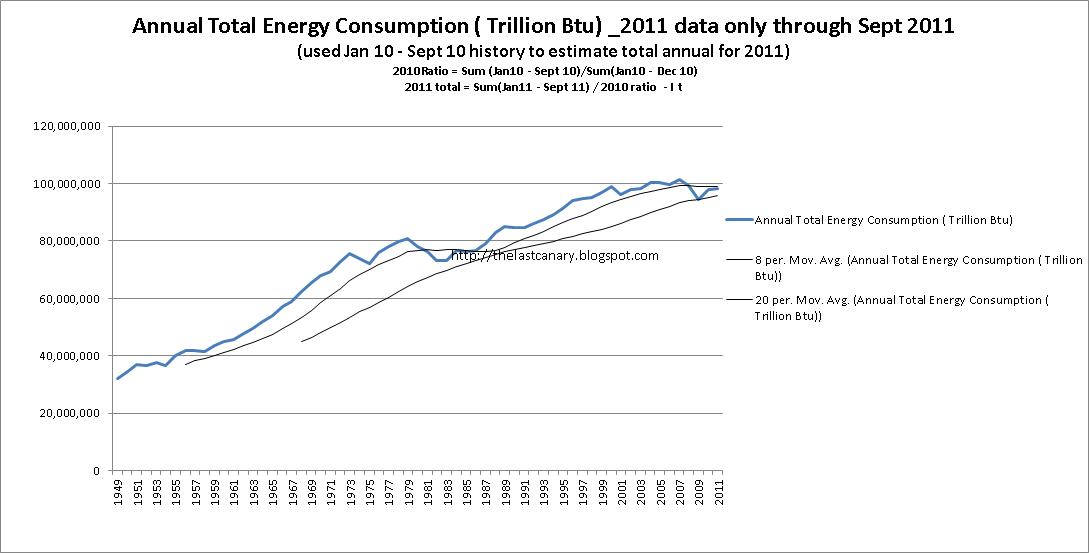
According to the U.S. Department of Energy’s Energy Information Administration, the U.S. used almost exactly the same amount of energy in 2011 as it did in 2010. In 2010 we used 98.16 quads and in 2011 we used 98.29.

Is that good, bad or indifferent? The two numbers aren’t enough to tell.

Because our population grew by more than 3 million people, at least it didn’t rise by one quad-as I wrote earlier, we use about 1 quad for every 3 million people. In 2010 our population was counted at 310.83 million and in 2011 it was estimated at 313.84. But that’s still not good enough. Our energy use per capita rose, although only a little.

Although our GDP grew by half a trillion dollars, we are not getting more bang for our energy buck. In 2010 our GDP was $13.088 trillion and it rose to $13.506 trillion in 2011. We are using more energy to produce 1 unit of GDP than we did in 2010. That’s also bad.

However, our carbon dioxide emissions declined by 500 million metric tonnes (equivalent, which means adding in emissions of other greenhouse gases and converting that to an equivalent amount of CO2 emissions). Our emissions in 2010 were estimated at 5,633.6 million metric tonnes in 2010 and 5,600 in 2011. And that’s good. It means we are converting from coal to gas and continuing the grand experiment with hybrids and renewable sources of energy.

One metric out of three is positive. That’s not good enough.

The Arab Spring Leads to Summer

What do rich people spend their money on?

Kuwait is a rich country. Their GDP per capita is $47,982–pretty close to ours, which is $48,386. Nice to have oil in the back yard, or at least natural gas–here in the U.S. we have both!

What’s important to the Kuwaitis? Energy. Not just oil, but energy. They use a lot–whereas in America the average citizen consumes about 310 mbtus annually, in Kuwait it’s 469 mbtus. You can see where some of it goes here.

60% of their energy use is residential. Guess why?

The undersecretary of Planning in the Kuwaiti Ministry of Electricity and Water put it another way, after noting that the average annual electricity consumption in Kuwait is 12,000 MW and it will double in seven years. Dr. Mishan Al Otaibi said “More than 70 percent of the country’s power generation is spent on comfort cooling”. He added  “By 2030, the demand will grow to 32,000 MW. Kuwait uses 350,000 barrels of oil per day to generate electricity, and in the next 15 years, this figure will climb to 1 million bpd.”

Dr. Otaibi was announcing for district cooling, not a bad idea. However, if I might suggest something, anybody using oil to generate electricity in a country that gets more sun than anything else might be missing the boat…

At the same conference where Dr. Otaibi was speaking, Fadhel Al Kazemi, CEO of Kazema Global Holding, said HH the Amir of Kuwait has laid great stress on the need to cut carbon dioxide emissions, fuel consumption and decrease electricity demand. The CEO broadsided Kuwait for providing the most subsidized electricity in the Gulf region known for its lavish subsidies. “We produce at 238 fils and sell at 2 fils per KW hour.

Whether it’s through district cooling, solar power or bringing icebergs up from the Antarctic, Kuwait will probably succeed in lowering the energy intensity of their air conditioning.

Two points:

  1. Most of the developing world will be richer than Kuwait is today by 2075. They too will want air conditioning–or its equivalent, depending on their latitude and attitudes. Their energy consumption will tend to want to double–just like Kuwait’s.
  2. Once the developing world is rich enough, they want to lower their energy consumption. Hope for the future and all that…

The Best Example of Energy Efficiency I Can Provide

Rutt Bridges is currently Chairman of Transform Software and Services. He is also an alumnus of Georgia Tech, one of the first graduates of what was then the School of Geosciences.

He contributed this article to Judith Curry’s blog at Climate Etc. It has saved me a lot of energy needed to explore issues related to natural gas, electricity and energy. I cannot recommend it highly enough.

Here is just one of the many charts in his article.

What The World Needs Now

You can sing along.


How Do We Deal With Good News About Energy?

Because so much of the conversation about energy issues is oriented around changing the behaviour of people in their homes and cars, in governments in their policies, taxes and regulations and in corporate practice, most of what you read has a Voice of Doom quality to it. And I might fall into that trap from time to time… But there is good news out there, too.

If I can try and introduce a note of optimism, let’s talk about U.S. energy consumption for just a second. Many people have noted that consumption peaked in 2007 at 101.3 quads. It dropped to 94.5 as the recession bit and climbed back up to 97.7 the next year. But last year it dropped again, to 97.5 quads. This is with GDP growth and population rise.

More importantly, look at fossil fuels over the same period. Their consumption also peaked in 2007, at 86.2 quads. The succeeding years showed FF totals at 78.4, 81.1 and 80.

So although overall consumption picked back up and has now leveled off, fossil fuel consumption dropped more and picked less back up.

So we not only might be seeing a plateau (won’t use the word peak) in demand, the mix is getting greener.

Does that cheer anyone up? In only 4 years, fossil fuels dropped from 85% of our portfolio to 82%.

Hooray! Or something like that. Link is here: http://www.eia.gov/totalenergy/data/monthly/pdf/sec1_3.pdf

I should add that even within fossil fuels there is change brewing, with coal decreasing and natural gas increasing. So: we’re using less energy than in 2007. Of that lower figure, a lower percentage is produced by fossil fuels. Of that lower percentage, more is natural gas, which produces less CO2 than the coal it replaces.Who’s got the bubbly on ice?

What Correlates With Energy Consumption?

Well, after yesterday’s comparison of Texas and California, which are at the opposite ends of the spectrum regarding energy consumption per person per year, I thought I’d take it a bit further.

Here is a ranked list of 49 of the 50 states (missing Hawaii and Washington D.C. at the moment): Energy per capita with other factors, US 2009

The average for the entire U.S. was 308 mbtus (million British Thermal Units) per person per year for 2009. That compares favorably with Canada (427 mbtus  per capita) but not so well with Germany (250 mbtus).

However, there is more variation found within the United States than between the U.S. and other developed countries. New York has per capita energy consumption of 196 mbtus. Wyoming has consumption of 956 mbtus, higher than Kuwait, Qatar…

Because Germany is a well-developed, high infrastructure country that even has autobahns without speed limits, I think they could serve as a goal for U.S. energy efficiency enthusiasts such as myself. So it’s nice to begin this with the observation that nine U.S. states (Maryland, Florida, New Hampshire, Connecticut, Arizona, California, Massachusetts, Rhode Island and New York) all have already achieved this target.

And there are really only 13 states with per capita energy consumption above 400 mbtus (Wyoming, Alaska, Louisiana, North Dakota, Iowa, Texas, South Dakota, Kentucky, Nebraska, Montana, Indiana, Alabama and Oklahoma).

There are some other points of interest:

  • The median household income for the 13 worst states is $46,816. The median household income for the 9 best performing states is $58,016. Those who say that rising incomes lower energy consumption may have a point, although it could be that wealthier people prefer Connecticut to North Dakota…
  • The average population density per square mile for the 13 worst states is 58.3. The average population density per square mile for the 9 top performers is 488. Urbanization is the environment’s best friend.
  • The average insolation (a measurement of how much sunlight an area receives) for the 13 worst states is 3.97. The average insolation for the 9 best performing states is 4.21.
  • The average residential electricity rates in the 13 worst states in 2010 was 9.85 cents per kilowatt hour. The average residential electricity rates in the 9 best performing states in 2010 was 15.29 cents per kilowatt hour. Incentive to conserve…

Have a look at the data and let me know what else you find that’s interesting.

State Population density (2011) Energy consumption per capita Detached Housing Median Income Ave. Insolation
 Wyoming 5.851 956 145,260 52,664 4.25
 Alaska 1.264 907 152,688 66,953 2.09
 Louisiana 105 750 1,184,167 42,492 4.76
 North Dakota 9.916 661 179,821 47,827 3.68
 Iowa 54.81 472 911,987 48,044 3.77
 Texas 98.07 456 5,171,892 48,259 4.83
 South Dakota 10.86 444 217,681 45,043 3.87
 Kentucky 110 435 1,156,003 40,072 3.9
 Nebraska 23.97 423 519,763 47,357 3.98
 Montana 6.858 422 276,433 42,322 3.96
 Indiana 181.7 409 1,802,259 45,424 3.87
 Alabama 94.65 405 1,300,272 40,489 4.34
 Oklahoma 55.22 404 1,080,624 41,664 4.36
 West Virginia 77.06 393 583,695 37,435 3.73
 Mississippi 63.5 386 791,569 36,646 3.59
 Kansas 35.09 385 818,954 47,817 4.11
 Arkansas 56.43 365 809,373 37,823 4.46
 South Carolina 155.4 347 1,078,678 42,442 4.15
 Minnesota 67.14 344 1,399,993 55,616 3.68
 Tennessee 155.4 340 1,642,085 41,725 4.04
 New Mexico 17.16 334 475,829 43,028 4.97
 Idaho 19.15 330 369,924 44,926 4.24
 Maine 43.04 327 439,459 45,734 3.82
 Ohio 281.9 315 3,221,505 45,395 3.83
 Wisconsin 105.2 309 1,531,612 49,993 3.69
88.08 inhabitants per square mile (34.01 /km2) 308
 Washington 102.6 305 1,527,867 56,548 3.53
 Missouri 87.26 304 1,679,585 45,229 4.09
 Virginia 204.5 303 1,810,353 59,330 3.9
 Georgia 169.5 301 2,107,317 47,590 4.37
 Illinois 231.5 296 2,831,011 53,966 3.72
 Colorado 49.33 290 1,122,331 55,430 4.55
 Pennsylvania 284.3 290 2,935,248 49,520 3.84
 Delaware 464.3 288 191,688 56,860 3.84
 Oregon 40.33 279 911,595 48,457 3.82
 New Jersey 1,189 275 1,794,967 68,342 3.63
 North Carolina 198.2 272 2,267,890 43,674 4.2
 Michigan 173.9 271 2,988,818 45,255 3.58
 Utah 34.3 271 520,101 55,117 4.53
 Nevada 24.8 268 432,437 53,341 5.3
 Vermont 67.73 254 193,229 51,618 3.43
 Maryland 596.3 251 1,097,673 69,272 3.98
 Florida 353.4 232 3,816,527 44,736 5.26
 New Hampshire 147 229 341,299 60,567 3.58
 Connecticut 739.1 224 816,706 67,034 3.59
 Arizona 57.05 221 1,244,172 48,745 5.38
 California 241.7 217 6,883,493 58,931 5.4
 Massachusetts 840.2 216 1,374,479 64,081 3.58
 Rhode Island 1,006 207 241,202 54,119 3.64
 New York 412.3 196 3,198,486 54,659 3.53

Texas vs. California

The two states are ranked #1 and #2 in population. Texas has an area of 269,000 square miles and a population density of 98 people per square mile while California has an area of 163,000 square miles and a population density of 242 per square mile.

Is population density a sufficient explanation for the differing rates of energy consumption? Texas consumed 456 mbtus per person in 2009, compared to 217 mbtus per person in California.

I don’t know the answer. Any ideas from commenters? Los Angeles is the second largest metropolitan statistical area (MSA) in the country, with almost 13 million people, but Dallas/Ft.Worth/ Arlington is 4th and Houston 6th, and taken together they equal Los Angeles.

I really don’t know and I really would like to know. Why does Texas use twice as much energy per person as California?

California uses more gas for transportation than Texas (17 billion gallons vs. 12 billion). The geography and climate have similar extremes in terms of deserts and temperatures. The average square footage of homes in Texas was 2,168 sq ft in 2005, 500 more than the 1,607 in California. However, the average annual energy consumption per square foot was higher in California (41.7 thousand BTUs) than  in Texas (37.6). California has 6.88 million single family detached homes, compared to Texas’ total of 5.17 million.

California’s median household income in 2010 was $58,931 compared to Texas’ median HHI of $48,259.

Help me out here, please. If population density is the single most important factor, that’s pretty important information. And yet I don’t recall reading much about population density and its effects on energy consumption.

(I should note that New York City consumes 1% of the country’s energy. However it has 3% of the country’s population….)

Pointing Towards Energy Consumption Solutions

Before we start hectoring China to start reducing energy consumption (watch it peak about 2050, though), we should take a look at our own.

The United States uses about 100 quads per year right now. Unless you’ve been reading this blog or have related interests, that figure probably doesn’t mean very much to you. Here’s what a quad really is. 100 quads is really a lot of energy–about 20% of world consumption by about 6% of the world’s population.

Another way to look at energy consumption is to look at how much energy is consumed per person per year. In the United States we are using about 310 million British Thermal Units per person per year. (What’s a British Thermal Unit? See here.)

That’s a lot of energy, but not as much as people burn in Canada (427 mbtus per capita) or Iceland (560 mbtus per capita), but as we have more people, that’s scant comfort.  If we reduced our average consumption by 20%, to about 250 mbtus per person, we’d be using energy at the same rate as the Germans (245 mbtus per capita).

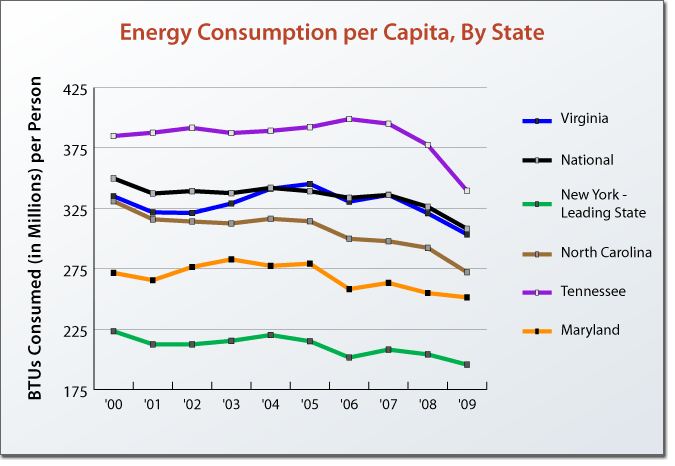
Well, would that involve major sacrifice? We might ask Maryland, which used 250 mbtus per capita in 2009. Or New York, which used 196 mbtus in the same year. They’re actually fairly sophisticated, high infrastructure places–kinda like Germany. The trick is for places like Tennessee (331 mbtus per capita) to catch up with the leaders. Here’s how it looks on a map.

We do this all the time in other fields. We establish a benchmark (250 mbtus per person), provide assistance to those in the back of the pack, reward achievement and penalize those who don’t make an effort.

And it works wherever it’s tried (and done well).