China and Coal

China has worked hard to develop alternative sources of energy. They were picked to lead in solar installations this year before Wen Ji Bao announced in March that they were not going to blindly throw renewables up everywhere at random. Nobody really knows what the ramifications of that statement are as of yet.

China has put in place the infrastructure to supply the world with wind turbines and solar panels. It leads the world in building dams for hydroelectric power. They don’t seem to be doing too much in the realm of biofuels, from what I’ve read, but are eagerly looking for frackable gas supplies–and have found some big deposits.

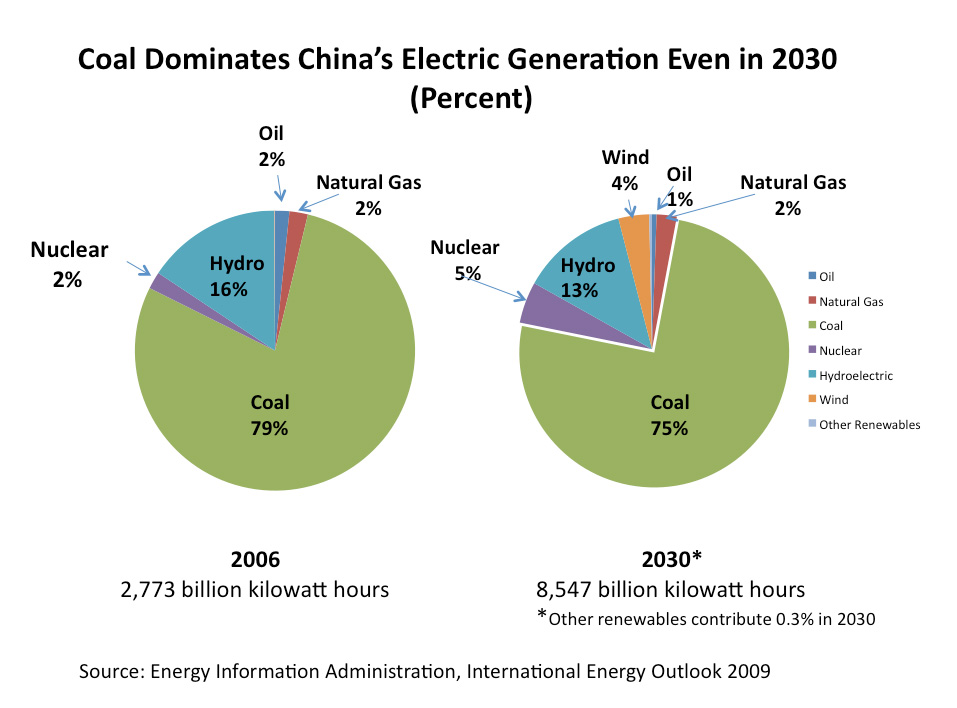
But for all that, it’s coal, folks. China depends on coal today. China will depend on coal in 2030. Bearing in mind my projection that China will be using 247 quads in 2030 (as opposed to 100 last year), this chart is sobering:

If my total of 247 quads is correct, that would indicate 185 quads of coal alone. That compares to 56 quads China got from coal in 2010.  That is more than the 156 quads the world got from coal in 2010. 

And I was going to start this post off with the cheerful news that in the U.S., coal consumption dropped by 5% last year, to under 20 quads. Oh, well.

Fuel Portfolio of Choice

It is clear that we will be using a broad mix of fuels to generate the energy we will need. I have predicted here that the total will be higher than the Department of Energy’s Energy Information Administration, but whether you believe their figures or mine, it would be foolhardy to walk away from any of the sources of energy we currently have.

Bearing in mind that the U.S. used about 100 quads last year, have a look at the table released today by the EIA regarding how much energy we are getting from renewables:

U.S. Renewables & CO2 Emissions Summary
2010 2011 2012 2013
Conventional hydroelectric power only. Hydroelectricity generated by pumped storage is not included in renewable energy.
Fuel ethanol and biodiesel supply represent domestic production only.
U.S. Renewables Supply (quadrillion Btu)
Hydroelectric Powera 2.539 3.171 2.779 2.660
Geothermal 0.208 0.222 0.227 0.228
Solar 0.109 0.114 0.128 0.139
Wind 0.924 1.168 1.327 1.388
Wood 1.979 1.967 1.975 2.005
Ethanolb 1.127 1.183 1.174 1.171
Biodieselb 0.039 0.110 0.110 0.128
Other Renewables 0.479 0.482 0.491 0.501
Total 7.404 8.418 8.189 8.220

Eight percent from renewables isn’t peanuts.  The kicker is the 2 quads we get from wood–we probably don’t really want that to be so high. Hydroelectric is going to have a down year, which masks the growth in solar, wind and biofuels.

Those 8 quads and 8% are roughly matched by nuclear power, which produced 8.44 quads in 2010. That gets us to almost 17 quads and 17% of the current total, which is really quite respectable.

What’s tough is looking at expected growth out to 2030. The EIA forecasts that nuclear will grow at 0.4% per year, yielding 9.55 quads in 2030. They expect 1.7% annual growth from renewables, which would take it to 11.1 quads. That’s 20.65 quads, which will be 19% of the total 108 quads they project for the U.S. in 2030.

Could do better…

I’ll say again I think their forecast of 108 quads in 2030 for the U.S. seems low. That’s scary. I think their forecast of renewable and nuclear energy is also low. That’s cheering.

This is kind of a high stakes race we’re watching. Hope we get it right.

Policy Implications of Increased Energy Consumption

So far I believe I have made a credible case that the world will consume close to 1,000 quads in 2030, far more than the 721 projected by U.S. and international agencies. If I’m off, I’m not off by much. I have a long way to go to make the case that consumption will continue to increase to 2,000 quads by 2050 and 3,000 by 2075, but the short term case looks pretty solid.

What does that mean for us? I would like to examine the implications for public policy and would definitely like your input.

I think the first finding would be that the decision by Germany and Japan to retire most or all of their nuclear power generation is something they will regret fairly quickly. Japan imports almost all of its fuel at present, while Germany’s replacement for nuclear may well end up being the dirtiest of brown coal sources. The fungible nature of fossil fuels and the market structure of the energy sector pretty much guarantees that an unexpected increase of 25% in demand will cause energy prices to rise dramatically.

The second thing to jump out at me is that, along with other major fuel-rich countries, the U.S. stands to benefit greatly from this development, a point I have seen made recently in major media, from Tom Friedman’s semi-jocular question about the U.S. joining OPEC to more serious analysis of our improved balance of trade.  The U.S., which still has a lot of oil, gas and coal, should be able to not only meet domestic demand, but sell a lot of it abroad. The U.S. will be happily joined by countries like Brazil, Russia and Nigeria. Major importers like China, India and Japan will have to make adjustments in their policies as well as their markets.

The third effect is the boost that rising oil prices will give to renewable energy. Ethanol will be back and more investment will be made in the sexy new fourth generation biofuels–heck, maybe one of them will work. But gas prices will rise, too–in part because the infrastructure to transport it is only partially built and in part because demand will outstrip even the huge supplies of frackable gas. And as that happens, the other renewables–wind and solar–will begin to compete on cost as well as ‘ethical purity‘. Not a minute too soon.

I believe there will be a chain reaction of consequences beyond the three I’ve mentioned here–and I would welcome input from those of you with time to give it some thought.

The Return of the Negawatt

If I find a new apartment that is $1,000 cheaper than my current abode, I save more than $1,000. That’s because I have to earn more than $1,000 to receive that amount in my bank account.

I’m looking at some stories about conserving energy. Energy efficiency is something we don’t pay enough attention to, because it isn’t sexy, it doesn’t create a new structure, etc., etc.

For example, this story about Marriott using 860,000 fewer kilowatt hours simply by converting to LED lighting at its corporate campus. It should tick a lot of boxes. The switch will save them $120,000 per year in combined energy and maintenance savings. That may not sound like much at first, but remember we’re talking about… changing lightbulbs.

It’s been a difficult few years economically, and people everywhere are looking for ways of saving money. IT managers are cleverly off-shoring some energy consumption by virtualizing servers, which they report as saving them 28% of energy costs and moving to the cloud, which saves them 17%.

Funnily enough, the easiest move they reported making was switching to Energy Star devices, which saved them 20% on power costs. I say funnily enough because I was just looking at another story about Energy Star. 40,000 products have an Energy Star sticker and their usage has reduced U.S. power consumption by $18 billion–last year alone.

Sadly, what blows my mind in reading stories about energy efficiency is what they don’t talk about.

Every watt you choose not to use is actually 3 watts not consumed. That’s because the average efficiency of power plants is a pretty sad 35% (although it’s getting better, thanks to combined cycle natural gas and other innovations).

What that means is, like me having to earn about $1,400 to get that $1,000 in my pocket, the energy saved by Marriott when they bought those LED lightbulbs was a lot more than 860,000 kwh–it was more like 2,700,000. It just doesn’t get reported because it never appeared on their utility bills in the first place…

Comparing population estimates

Faithful readers will recall that I used the U.S. Census Bureau’s International Estimates of population for my analysis of the developing world’s energy use and switched to the UN’s medium variant for my estimate of the OECD’s energy consumption.

Here I’ve put them side by side in a spreadsheet, along with the UN’s low and high variants. Those who want to take a look will see that the UN’s medium variant and the Census Bureau’s projections are pretty similar, so I don’t feel the burning need to homogenize datasets in the very near future (but I will do so eventually and will let you know when it’s done). For those of you keeping track, in 2050 the UN Medium Variant projection for the world is 9.31 billion while the US Census Bureau’s estimate is 9.44 billion. For longer term projections, the UN  Medium Variant gives for 2075 a number of 9.9 billion and for 2100  a total of 10.24 billion. (Those of you who tend to suspect that the UN projects on the high side should note that the Census Bureau is higher than the UN Medium Variant…)

The Census Bureau’s numbers only go through 2050, so I’ll probably end up using the UN’s figures. However this is laborious and I’m busy…

The spreadsheet is here: Population Comparisons, UN and US Census Bureau

It’s not just the CO2. Why Coal Must Go

One of my favorite authors is Eric Blair, better known as George Orwell. One of my favorite books of his is The Road To Wigan Pier. One of my favorite passages from that book concerns how England got coal from the ground.

So when Brad DeLong published this passage today, I just thought I’d grab it and post it. People who lament the loss of ‘manufacturing’ jobs don’t typically work in manufacturing. I personally think we should have a national holiday celebrating the day when the percentage of people working in agriculture fell below 3% in this country, and eagerly await the day when we can say the same about manufacturing–and mining.

“Even when you watch the process of coal-extraction you probably only watch it for a short time, and it is not until you begin making a few calculations that you realize what a stupendous task the ‘fillers’ are performing. Normally each man has to clear a space four or five yards wide. The cutter has undermined the coal to the depth of five feet, so that if the seam of coal is three or four feet high, each man has to cut out, break up and load on to the belt something between seven and twelve cubic yards of coal. This is to say, taking a cubic yard as weighing twenty-seven hundred-weight, that each man is shifting coal at a speed approaching two tons an hour. I have just enough experience of pick and shovel work to be able to grasp what this means. When I am digging trenches in my garden, if I shift two tons of earth during the afternoon, I feel that I have earned my tea. But earth is tractable stuff compared with coal, and I don’t have to work kneeling down, a thousand feet underground, in suffocating heat and swallowing coal dust with every breath I take; nor do I have to walk a mile bent double before I begin. The miner’s job would be as much beyond my power as it would be to perform on a flying trapeze or to win the Grand National. I am not a manual labourer and please God I never shall be one, but there are some kinds of manual work that I could do if I had to. At a pitch I could be a tolerable road-sweeper or an inefficient gardener or even a tenth-rate farm hand. But by no conceivable amount of effort or training could I become a coal-miner, the work would kill me in a few weeks.

Watching coal-miners at work, you realize momentarily what different universes people inhabit. Down there where coal is dug is a sort of world apart which one can quite easily go through life without ever hearing about. Probably majority of people would even prefer not to hear about it. Yet it is the absolutely necessary counterpart of our world above. Practically everything we do, from eating an ice to crossing the Atlantic, and from baking a loaf to writing a novel, involves the use of coal, directly or indirectly. For all the arts of peace coal is needed; if war breaks out it is needed all the more. In time of revolution the miner must go on working or the revolution must stop, for revolution as much as reaction needs coal. Whatever may be happening on the surface, the hacking and shovelling have got to continue without a pause, or at any rate without pausing for more than a few weeks at the most. In order that Hitler may march the goose-step, that the Pope may denounce Bolshevism, that the cricket crowds may assemble at Lords, that the poets may scratch one another’s backs, coal has got to be forthcoming. But on the whole we are not aware of it; we all know that we ‘must have coal’, but we seldom or never remember what coal-getting involves. Here am I sitting writing in front of my comfortable coal fire. It is April but I still need a fire. Once a fortnight the coal cart drives up to the door and men in leather jerkins carry the coal indoors in stout sacks smelling of tar and shoot it clanking into the coal-hole under the stairs. It is only very rarely, when I make a definite mental-effort, that I connect this coal with that far-off labour in the mines. It is just ‘coal’–something that I have got to have; black stuff that arrives mysteriously from nowhere in particular, like manna except that you have to pay for it. You could quite easily drive a car right across the north of England and never once remember that hundreds of feet below the road you are on the miners are hacking at the coal. Yet in a sense it is the miners who are driving your car forward. Their lamp-lit world down there is as necessary to the daylight world above as the root is to the flower.

It is not long since conditions in the mines were worse than they are now. There are still living a few very old women who in their youth have worked underground, with the harness round their waists, and a chain that passed between their legs, crawling on all fours and dragging tubs of coal. They used to go on doing this even when they were pregnant. And even now, if coal could not be produced without pregnant women dragging it to and fro, I fancy we should let them do it rather than deprive ourselves of coal. But most of the time, of course, we should prefer to forget that they were doing it. It is so with all types of manual work; it keeps us alive, and we are oblivious of its existence. More than anyone else, perhaps, the miner can stand as the type of the manual worker, not only because his work is so exaggeratedly awful, but also because it is so vitally necessary and yet so remote from our experience, so invisible, as it were, that we are capable of forgetting it as we forget the blood in our veins. In a way it is even humiliating to watch coal-miners working. It raises in you a momentary doubt about your own status as an ‘intellectual’ and a superior person generally. For it is brought home to you, at least while you are watching, that it is only because miners sweat their guts out that superior persons can remain superior. You and I and the editor of the Times Lit. Supp., and the poets and the Archbishop of Canterbury and Comrade X, author of Marxism for Infants–all of us really owe the comparative decency of our lives to poor drudges underground, blackened to the eyes, with their throats full of coal dust, driving their shovels forward with arms and belly muscles of steel.”

Global Energy Consumption in 2030: Preliminary numbers and discussion of confidence levels

I have now done for the developed world what I tried to do for the developing nations–estimate energy consumption in quads for 2030. The total matches closely with the U.S. Department of Energy’s Energy Information Administration, which predicted 279 quads for the OECD in 2030. My total was 280.

So the difference is still the developing world. The DOE’s EIA estimates that the entire world will consume 721 quads in 2030–with the 279 coming from the current 34 OECD nations and the remaining 442 quads coming from the developing nations.

Using almost the same methodology that replicated the DOE’s estimate for OECD energy consumption (which I discuss next), I came up with a much higher total for the developing world. My total for developing countries in 2030 was 672.3 quads, so my global total is also higher–952.3 quads in 2030. Again, the difference, 231 quads, is very large–more than the entire consumption of China and the U.S. combined today. If I’m right, we will be using 24% more energy in 2030 than anybody has predicted to date. This has the potential to have major consequences.

There are two differences in the methodology I used when calculating the energy consumption of the developing world.

First, I used the U.S. Census Bureau’s population projections for the developing world, as opposed to the medium projection of the UN that I used for the OECD nations. Some time soon I will compare the two and report on any discrepancy. In any event, I will homogenize my data sources and use one set of figures.

Second, for the developing world I did not introduce a discount factor for energy efficiency. This was a conscious choice. I believe that energy efficiency is a factor in developing countries, but gets swallowed up by the massive appetite for growth. I think people moving into their first modern apartment in China will buy the cheapest washing machine available as opposed to the most energy efficient and that that will serve as an analogy for other decisions made regarding energy. Eventually that will change, and it will be a factor for later projections. But it’s too early to say that energy consumption will be mitigated by a 0.5% annual gain in energy efficiency for China and India as they move out of poor country status and into medium income territory. Happy to discuss any or all of this in comments.

As a rough first draft of projected consumption, I don’t think this is too bad. I believe my view of energy consumption in the developing world is superior to that of the DOE’s EIA. And, I have doubts about their view of American energy consumption, detailed in other posts here, here and here. After more study, I may add in higher estimates of American consumption that could push the global total close to 1,000 quads by 2030.

As you can see, I’m not done with all this yet. Data homogenization, comparing population estimates, etc. So I wouldn’t take this to the bank just yet. But it does honestly appear to me that the world’s energy consumption in 2030 will be significantly higher than projected.

A Short History of Fuel Substitution in the UK

Guest post by Dr. Alan Jones

Alan Jones is a physicist and engineer who has worked for the BBC and the UK Civil Service. He currently consults for various Commonwealth and British Crown Dependency governments. He is a passionate follower of technology and technology history and understands that context and perspective is key in understanding what’s happening with energy now and what choices we need to make for the future. He volunteers this history of the adoption of natural gas in the UK, with all the attendant lessons relevant to us today.

In the late 18th century the English learnt that coal [town] gas could easily be piped and stored to provide a brilliant light: so it spread quickly wherever coal could be moved by sea, river or canal. With the coming of the railways gas companies [Co‘s] sprang up along their routes. Many Co’s were private or public concerns, others owned by local councils eager to bring gas light to their communities.

The Co’s continued to expand until the 1880’s when they met a check in the electric lamp. They turned to Welsbach’s incandescent mantle which gave as good a light and, since burners could be retrofitted, was much cheaper. But it also used far less gas than an open flame so the Co’s ended up with serious overcapacity at a time when the chemical byproducts of gasification were becoming more valuable than the gas and coke themselves.

Their response was to grow by reaching new customers and providing new uses for gas, beginning with the gas geyser which gave hot water on demand: later followed by the gas cooker, the gas fire for room heating and even the gas refrigerator. By the 1950s they supplied almost all urban and suburban areas of the UK and began to run short of gas so they imported liquefied methane [LNG] by sea to enrich supplies.

By then they had been nationalised, over 1000 Co’s had been merged into regional boards [Boards] with no effective central authority. Whereas electricity had been increasingly regulated to prevent overcapacity by creating the National Grid and finally nationalised under the Central Electricity Generating Board [CEGB] which competed fiercely with gas.

But a new spectre haunted the Boards. that of cheap oil and petrochemicals.  Moreover the CEGB had a successful nuclear programme offering inexpensive off peak power. It was the nightmare of the 1880’s all over again.

Nothing daunted, the Boards answered knowing there were vast reserves of natural gas under the North sea and they had the infrastructure and expertise to distribute it very cheaply. The only question was how to get at it and convert the whole nation to it. So they set up their own joint committee, a very powerful one initially independent of the British government, [HMG], to consider the ways and means.

The Committee reported in 1962 and its views were straightforward and, with hindsight, both trenchant and prescient. They observed:

A] That the oil majors who had the technology to do this saw no profit in gas nor in oil given cheaper fields elsewhere. To induce them to drill the Boards would have to offer them long term contracts at a price which would reward them.

B] That methane had about twice the calorific value of coal gas by volume which would double the capacity of the existing infrastructure: and furthermore under low pressure could be supplied to new customers cheaply  using plastic pipes.

C] That since the Boards already had the necessary expertise the only problem was the sheer scale of the task: not only new pipelines but  also that some 200+ million burners would have to be converted or replaced.

D] Nevertheless they thought this practical if it were done in stages so the methane would reach each region step by step. They estimated complete conversion would take ten years.


E]  They assessed the likely overall economic benefit to the economy from cheaper energy as a one off gain of between ten and twenty percent in GDP over the ten years of conversion and might well create growth of half a percent per annum thereafter for many years as new customers came on line.

F] But they also cautioned: ‘No such major change in the energy base of a great industrial power in so short a time has ever been attempted before’.

It has never been attempted since either. But it was done.

HMG accepted the Board‘s report in 1963 and in 1964 the rig Sea Gem struck gas in abundance although due to political turmoil the reorganisation of the industry was not finalised until 1967 when the project was well underway and virtually complete by 1974. By then the first oil shock had sent energy prices soaring but not gas because the enabling Act only provided for a cost plus pricing basis: and the supply contracts were fixed price.

The results were astonishing: wherever and whenever the new gas arrived. Demand for fuel oil and paraffin [kerosene] declined rapidly as boilers were converted to gas. Central coal fired boiler houses, often producing electricity as well as district heating, quickly vanished: it was far cheaper and more efficient to pipe gas directly to where heat was wanted. Electric space heating almost disappeared. Even the mighty CEGB started to explore gas to meet peak loads and later dual phase gas/steam plant.

This latter changed HMG policy, which in the early 1980’s had been that a new generation of nuclear stations would be wanted but only one was built, the CEGB argued successfully that gas/steam stations were far cheaper than nuclear both in terms of capital and fuel cost. Indeed when the utilities were privatised in the 1990’s they opted to replace coal fired stations rapidly in the ’Dash for Gas’.

And still the gas marched on: over the sea to Ireland, North and South, and elsewhere. Its advance was temporarily slowed at the turn of century with HMG imposing taxes, havering about new permissions and such which led to a hiatus and short lived price spikes. But despite this UK consumers still enjoy some of the cheapest gas in Europe even with ‘green’ taxes on it.

Finally and at last, to the dismay of the Greens and their political, business and ‘meeja’ allies, there are signs that HMG is slowly turning back towards a new dash for gas, the UK has reserves for centuries to come, and exploiting them now would end the recession almost at a stroke.


© ajgjones 2012 whose moral right is asserted.

Energy Consumption in the OECD, Part C: It works!

I now have calculated the projected energy consumption for the 34 nations currently in the OECD at 2030.

It very much looks like the Department of Energy’s Energy Information Administration used the same methodology I describe below to come up with a 279 quad projection for the 34 OECD nations in 2030.

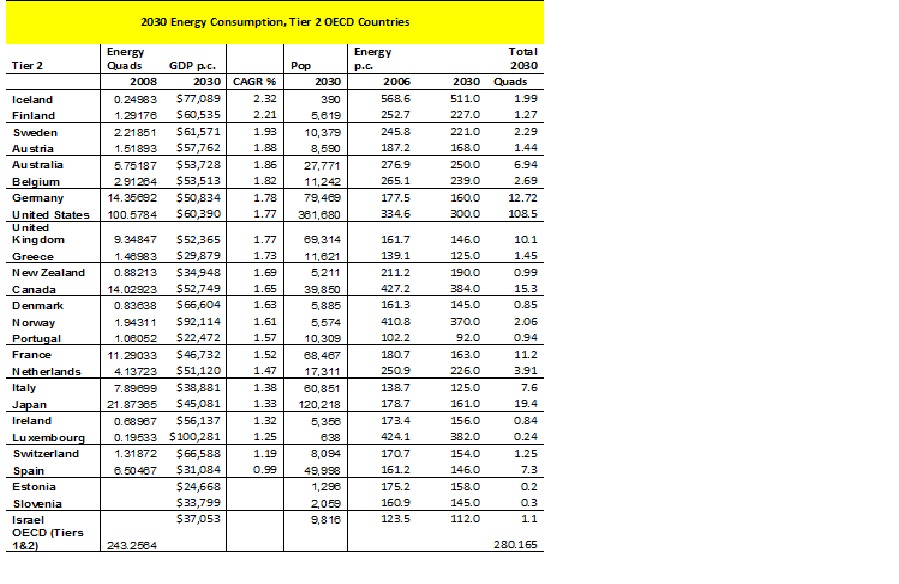
Here’s the data in Excel if you want to look (I have a table below but it’s kinda hard to read.) Energy Consumption in the OECD 2030

What I did was to take my higher growth projections for Tier 1 countries as described in the previous post. I then calculated energy use for the remaining 26 countries as follows:

  1. I took the medium population projection from the UN as published a couple of months ago.
  2. I reduced energy use per capita by 10% to follow predictions of energy efficiency gains predicted for that time period.
  3. I multiplied this lower per capita energy consumption by the number of capitas predicted for 2030

And the total was almost exactly what the DOE came up with. Mine was 280.16 quads compared to their 279 quads.

The reason I’m excited is that it provides indirect support for the choices I made in projecting totals for the developing world.

However, to actually look at this as an optimum methodology, we have to consider some potentially confounding factors.

The Rebound Effect. If our appliances, cars and buildings get more efficient, will that seduce us into consuming more energy? If so, then we must assume that the DOE built that in and the 0.5% per year gain in efficiency is net, not gross.

Secondly, Do we have reason to assume that the Tier 2 countries will have a homogenized gain of 0.5% per year? The current variation in energy consumption between Tier 2 countries is huge, ranging from 568.6 mbtus per person in Iceland to 102 mbtus per person in Portugal. The variation in predicted growth in GDP is also quite large in Tier 2 countries, ranging from a CAGR % of 2.3% in Iceland to 0.99% in Spain.

And the elephant in the living room in all of this is the U.S. Because it is so large in comparison to the rest of Tier 2 countries in the OECD (It has 34% of the population in all of Tier 2 and that will rise to 36% in 2030), if the U.S. does not experience the same 0.5% gain in energy efficiency, it has a disproportionate impact on the totals.

Finally, the UN has not had the greatest success in measuring further populations. Because my (and evidently the DOE’s) calculations are heavily dependent on population, if that goes south so do all of these nice calculations…

Energy Consumption in the OECD Part B

The first tier of OECD countries is characterized by high levels of growth predicted between now and 2030. They are, not surprisingly, less developed than other members of the OECD and quite simply have more room to grow.

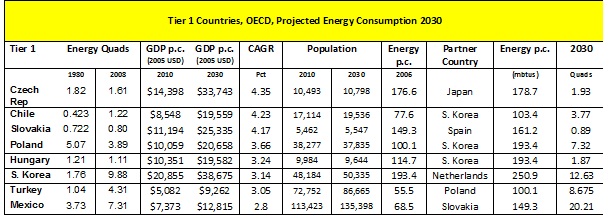
For this tier of countries I used the same methodology as I did when studying the developing world. I looked at their projected GDP per person for 2030. I then found a country (that did not look radically dissimilar in other ways) that had the same GDP per capita in 2008. I hijacked the partner country’s energy consumption per capita and multiplied it by the target country’s projected population for 2030 and voila:

This is rough substitution, folks, not an exact science. It has real advantages–it allows for judgement and doesn’t force a regional percentage on countries that don’t correspond to regional characteristics. But this should by no means be the final word on the issue.

The Tier 1 countries used 30.1 quads in 2008. My methodology shows projected consumption in 2030 of 57.3 quads. That’s a compound annual growth of 2.97%. This is quite high–remember that the DOE’s Energy Information Administration predicts 0.6% for the OECD as a whole. And although some OECD countries will actually show a decline in energy consumption, the high performance of Tier 1 countries will make it difficult to bring the bloc as a whole in under their projected figure of 279 quads in 2030. After all, just these 8 countries have already brought in 20% of the ‘allotted’ 279 quads, and the average per capita consumption in 2030 will be below the average for the entire OECD as it stands today.


Energy Consumption in the OECD in 2030, Part, umm, A

How many countries in the OECD will increase energy consumption as fast or faster than China?

Okay, here goes. Take a deep breath and follow the bouncing ball…

In 1980 the OECD consumed 178 quads. By 2008 that had climbed to 243 quads. The U.S. DOE projects OECD energy consumption at 279 quads in 2030, a compound annual growth rate (CAGR) of 0.6%.

In 2008 there was large variability in energy consumption per capita within the 34 OECD countries. The average for all 34 OECD nations was 205 mbtus per person per year, and the two countries closest to that average were New Zealand (211) and South Korea (193).

I was almost pleasantly surprised to learn that the U.S. is not the highest consumer of energy per person in the developed world. In the OECD, that honor goes to Iceland (569 mbtus per person per year), followed by Canada (427), Luxembourg (424) and Norway (411). The U.S. is number 5 with 335.

The lowest consumers of energy on a per person per year basis were Turkey, with 55.5 mbtus per person per year, Mexico (68.5), Chile (77.6) and Poland (100).

Guess which countries are expected to grow at the fastest rate between now and 2030? Turkey, Mexico, Chile and Poland…

So. Let’s acknowledge that the OECD is not a homogenous unit. Let’s accept that there are countries that are stable and will probably not increase their energy consumption much–that the DOE is correct about the 0.6% CAGR for these countries. And let’s look at what happens when we treat the other countries in the same way I treated developing countries. By finding ‘partner’ countries that we can compare their development path with.

For example. Chile’s income is expected to grow dramatically over the next 20 years, from $11,194 to $19,559 (measured in 2005 US dollars). The latter figure is pretty close to South Korea’s income in 2010. South Korea had a per capita energy consumption of 193.4 mbtus in 2008. It is not unreasonable to project that Chile’s energy consumption will be close to that in 2030. Chile’s population is expected to grow to 19.5 million by that time. Chile’s energy consumption could then approach 3.77 quads. As we know Chile consumed 1.21 quads in 2008, we can calculate the CAGR percentage. If Chile’s growth for the next 20 years brings them close to South Korea’s level of consumption it will be a CAGR of 5.3%. That’s not just higher than the DOE’s projection of 0.6%. It’s higher than China’s…

To be continued…


New Drivers of Energy Consumption

Again, this post is to tide you over until I finish my analysis of energy consumption in the OECD in 2030, which is only a day or so away from completion.

Much of the conversation I have seen (and what I’ve written) about energy consumption is about adoption of current technology by people in developing countries. As they get modern houses, cars, appliances and computers, it will increase energy consumption.

I have not seen much discussion of new ways of consuming energy. The last big driver of consumption seriously talked about was data centers, now estimated to consume 2% of U.S. electricity, I believe. But that’s not really new any more.

As a committed ‘Kurzweilian’, I’ve bought into the dream (if it’s an illusion, please just don’t wake me up) that three technologies will transform this century:  Nanotechnology, biotechnology and robotics. Ray Kurzweil has put forth the proposition that they will combine and advance so dramatically that it will put the development of electricity to shame. I think he’s right.

How will those technologies affect energy consumption?

I think the primary effect will come from robotics. It will take a lot of industrial energy just to manufacture them, of course. But once they take hold in a society, I think we will find more and more things for them to do, and running the darn things will consume energy as well. Whether robots end up being general purpose handymen or planted performers of a specific task, I fully expect robots to use as much energy as we who created them. And I expect for there to be a lot of them–maybe more of them than there will be of us.

This might be balanced by nanotechnology, which will, as the name implies, tend to make things smaller and lighter. We’ll still need industrial qualities of energy to create the products, but once in use they should use less energy than the objects and materials they replace. Cars should get even lighter, that kind of thing. And nanotechnology will certainly be used to make robots lighter and more efficient, because (in my own opinion) the big driver of robotics will be healthcare–and I’m not talking about robotic caregivers. Robotics will be the key driver in the development of prosthetics, and the size constraints of the limbs they replace will make any size advantages worth the expense.

As for biotechnology, for now it seems that its primary impact on the energy scene will be as potential augmentation of biofuels, making them more potent and less space consuming. And I think that’s going to be a real challenge–but the stakes involved mean that many are already trying for it and one or more will probably succeed.

Of course none of these three technologies address the toy that we all want to burn energy on–passenger flying cars… but as soon as those are built the engineers will get to work on making them more efficient…

Two Thoughts While I’m Working

While I’m laboring away on constructing a coherent theory of energy consumption in OECD countries at 2030, I’ve thought of two things to share with you. Working with actual data does that to me…

1. One reason that Angela Merkel may have felt able to throw nuclear under the bus is the fact that Germany’s population will decrease by 3 million souls between now and 2030. Fewer lightbulbs to power… The same logic may permit Japan to pursue similar non-nuclear policies, as their population will decline even more, by over six million people.

2. The data I’m looking at is tempting me to treat America as a (gulp… big one here) well, developing country. I know that sounds like a stretch and I’ll have to really make the case for it, but if you look at metrics like population per square kilometer (okay, mile–same difference) or historical growth in things ranging from GDP to population growth, we look a lot more like Brazil than we do Switzerland. Obviously you have to ignore our income and total GDP, but if you can ignore them you’d have to figure our best days are ahead of us. And since that’s what I want to believe (and have been writing about for years), I’m certainly going to look into it further.

Thanks for your patience. I should have the OECD projections done shortly.

Carving Up The OECD, Part 3

In yesterday’s post we divided the 34 OECD countries into three tiers based on projected growth in GDP through 2030. Let’s now consider some of the implications for energy consumption.

Energy consumption in the OECD grew from 178 quads in 1980 to 243 quads in 2008, a CAGR of 1.12%. (The figures include earlier numbers from countries that joined during the interim and countries that combined forces, like East and West Germany or split, such as the Czech Republic and Slovakia. So it is apples to apples.)

The U.S. Department of Energy’s Energy Administration projects that the growth in energy consumption will fall by almost 50% between now and 2030, from the 1.12% CAGR listed above to 0.6%, reaching a total of 279 quads by then. (Their projections go to 2035, but I use 2030 because another table I intend to use stops at 2030. For the curious, the EIA projects OECD energy consumption to continue rising to 288 quads by 2035.)

In the three Tiers of OECD countries that I created by fiat yesterday, here is how  energy consumption broke out in 1980 and 2008:

Tier 1 (8 countries predicted to have high growth in GDP, ranging from 2.8% to 4.35%). In 2010, these countries (the Czech Republic, Chile, Slovakia, Poland, Hungary, South Korea, Turkey and Mexico) accounted for 12% of the OECD’s energy consumption.

1980: 15.8 quads

2008: 30 quads

The real growth in energy consumption for Tier 1 countries from 1980 through 2010 was 2.32% CAGR.

The EIA estimates by region going forward, so I cannot offer breakouts of their projection through 2030. However, their projection for Mexico/Chile is 2.1%, OECD Europe is 0.5% and OECD Asia is 0.7%.

Given that the energy consumption of this tier of countries grew at double the rate of the rest of the OECD and that their GDP is projected to grow at double the rate of the rest of the OECD through 2050, I think it is safe to say that the energy consumption of this group will grow at a more robust rate than 0.6%

Perhaps this will be compensated for by slower than average performance in the other two tiers. But what it means for me is I will have to go back to the same methodology that I used for estimating growth in energy consumption for the developing world. This will take time and effort.

I must say that it is surprising that this is so hard to find for OECD countries. I anticipated some difficulty with getting good statistics for the developing world, but the OECD?

Don’t forget about me while I’m buried in Excel spreadsheets, but don’t expect another post really quickly.

Carving Up the OECD, Part 2

Back in 2010, a gentleman by the name of Dr. Mathew Shane, working at the U.S. Department of Agriculture’s Economic Research Service calculated GDP per capita by country through 2030. His sources were: World Bank World Development Indicators, International Financial Statistics of the IMF, HIS Global Insight, and Oxford Economic Forecasting, as well as estimated and projected values developed by the Economic Research Service all converted to a 2005 base year. The Excel spread sheet he published can be downloaded here: projectedrealpercapitaincomevalues

Thank you, Dr. Mathew Shane.

I have grouped member countries of the OECD below, based on the CAGR percentage of GDP per capita growth.

It didn’t break out the way I expected. Where I thought it would be a 5%, 3%, 1% split, according to Dr. Shane’s work the  real breaks are 3% and up, 1.5% to 3% and below 1.5%. So at this point, accepting his figures (remember they’ll look low because they are all in 2005 U.S. dollars, and ain’t inflation an amazing thing…) here’s how it splits out. Analysis and implications are for Part 3.

Tier 1

Energy Quads GDP per capita (2005 USD)
1980 2008 2010 2030 CAGR %
Czech Republic 1.8222 1.61454 $14,398 $33,743 4.35
Chile 0.42668 1.2154 $8,548 $19,559 4.23
Slovakia 0.7222 0.8022 $11,194 $25,335 4.17
Poland 5.06796 3.88691 $10,059 $20,658 3.66
Hungary 1.20988 1.1062 $10,351 $19,582 3.24
Korea, South 1.75836 9.88495 $20,855 $38,675 3.14
Turkey 1.04087 4.30511 $5,082 $9,262 3.05
Mexico 3.72819 7.30898 $7,373 $12,815 2.8

Tier 2

Energy Quads GDP per capita (2005 USD)
1980 2008 2010 2030 CAGR %
Iceland 0.05705 0.24983 $48,756 $77,089 2.32
Finland 0.97218 1.29176 $39,100 $60,535 2.21
Sweden 2.0745 2.21851 $42,044 $61,571 1.93
Austria 1.09577 1.51893 $39,766 $57,762 1.88
Australia 2.74246 5.75187 $37,188 $53,728 1.86
Belgium 2.06423 2.91264 $37,320 $53,513 1.82
Germany 14.86407 14.35692 $35,742 $50,834 1.78
United Kingdom 8.84074 9.34847 $36,888 $52,365 1.77
United States 78.12376 100.5784 $42,517 $60,390 1.77
Greece 0.75171 1.46983 $21,194 $29,879 1.73
New Zealand 0.51056 0.88213 $24,985 $34,948 1.69
Canada 9.6947 14.02923 $38,043 $52,749 1.65
Denmark 0.86306 0.83638 $48,193 $66,604 1.63
Norway 1.34103 1.94311 $66,952 $92,114 1.61
Portugal 0.4315 1.06052 $16,463 $22,472 1.57
France 8.38909 11.29033 $34,529 $46,732 1.52

Tier 3

Energy Quads GDP per capita (2005 USD)
1980 2008 2010 2030 CAGR %
Netherlands 3.20474 4.13723 $38,206 $51,120 1.47
Italy 6.14607 7.89699 $29,559 $38,881 1.38
Japan 15.20992 21.87365 $34,589 $45,081 1.33
Ireland 0.32304 0.68967 $43,184 $56,137 1.32
Luxembourg 0.14196 0.19533 $78,150 $100,281 1.25
Switzerland 1.13892 1.31872 $52,534 $66,588 1.19
Spain 3.04408 6.50467 $25,510 $31,084 0.99

Carving up the OECD, Part 1

We are now going to put countries into one of three buckets–the 5% bucket, 3% bucket or 1% bucket. Those percentages are the mid-range of growth in energy consumption that I will project for them between now and 2050. Unlike other, more sophisticated models, I will use cruder metrics–projected growth in population and GDP per capita. And, although I think these cruder metrics will be closer to the final outcome than the more sophisticated models being used today, for now I think it’s best to characterize this effort as an effort to provide an alternative set of numbers for comparison’s sake.

We’ll start with the OECD. It is common practice to treat the OECD as a monolithic bloc, for analysis of energy and GDP and much else besides. This may have been acceptable when the OECD had its original membership of 20 countries, but now that membership has grown to 34, the differences between members are getting too large to ignore. As the OECD has now offered enhanced engagement to Brazil, China, India, Indonesia and South Africa, the differences in development paths that members take will only grow.

Energy consumption in the OECD grew from 178.9 quads in 1980 (the DOE EIA’s figures do include where possible figures for countries that later joined, so it’s almost apples to apples–three countries didn’t have figures for 1980) to 243.3 quads in 2008, a CAGR of 1.1%. (That’s very low, obviously–but remember that the EIA actually projects growth going forward at less than half that rate, having adjusted their projection downwards from 0.6% to 0.4% through 2035.)

However, reporting at group level does hide significant variation. Australia, for example, grew at 2.68% annually and Turkey nearly matched that with growth of 2.65%. But their respectable growth is masked by slow growth in larger countries like Germany, which saw its energy consumption decrease since 1980, as East Germany abandoned loss-making inefficient manufacturing.

So, before I present the results, it’s time for another expression of frustration at the thinking that goes into this type of analysis. Follow the bouncing ball, here.

The OECD expects the population of its member states to grow at 0.2% per year through 2050, reaching a total of 1.33 billion souls, up from 1.22 billion in 2009, a total increase of 111 million people. Ooookayyy, but their population growth rate for the past 12 years was three times that rate… and they also project that 15 of their member states have been growing faster than that 0.2% annual average. Those 15 states have 56% of the OECD’s population.

So I’ll stop part one of this extravaganza with the observation that I am not confident of their population projections–the U.S. is an OECD member. Even using the Middle Series population projections of the U.S. Census Bureau provides a growth rate of 1.07% through 2050. The U.S. constitutes 25% of the population in OECD countries. The growth in population in the U.S. alone is expected to be 92 million people.

Nor am I confident that a population that is growing at any rate at all can be counted on to reduce their energy consumption growth rate by half.

Well, let’s move on to Part 2.

The 5-3-1 Analysis Frame

If you’ve read much of this weblog, it should be clear that the traditional way of looking at energy consumption hasn’t been extremely useful.

It doesn’t break out simply, such as OECD vs. non-OECD nations. There are huge differences within those groupings that have led those who do meta-analysis into some strange territory.

So I’m going to offer something different. Let’s imagine a new way of looking at the world–hopefully a way that better corresponds to reality.

I intend to group nations into buckets based on estimated future growth of energy consumption. For the moment, I will label those buckets 5%, 3% and 1%, although I may refine them later.

The 1% bucket will consist of those European  nations that are reclining, if not declining, in population and other criteria that drive consumption. They will be joined by some countries, mostly in Africa, that would otherwise be called Failure to Launch. This may be the African Century yet, but this subset of countries haven’t heard the news.

The second group is important, mostly because it includes the U.S., the largest economy and second-largest energy consumer in the world. It will be joined by a number of countries that might be called the Balanced Set–those that will grow, but moderately. They will be the 3% club.

And then there will be the 5% group of hard chargers–the Chinas, Indias and Indonesias of the world, in a hurry to develop and fight their way to the top.

I’m hoping that analyzing future energy consumption will be not only easier this way–I’m hoping that it will have a very natural flow to it, as if we’re swimming with the current when we look at the numbers, as opposed to fighting upstream to make sense of it all.

I hope you stick around for the ride.

The Importance of Choice

Having a viable substitute for something you want to change is important. I didn’t quit smoking until I found nicotine gum. That was despite a very clear understanding of what smoking was doing to me and those around me.

Ten coal plants are being retired from service, it was recently announced, bringing the number of such retirements to 106–coal plants in the U.S. that have shut up shop or are planning to do so.

A variety of reasons are given for these closures–rising costs of coal, new and stiffer regulations by the EPA–but the fact is that these closures are possible because of the availability of low cost natural gas. When a substitute becomes available, it changes the way decisions are made.

Roger Pielke Jr. has a post up over at his eponymous weblog about the cost of gas at the pump expressed as a proportion of GDP. He  notes that a 70% rise in the cost of gas at the pump has only pushed spending on gasoline from 2.8% to 3.8% of our GDP. Pielke speculates that the calculus on gasoline changed when China began consuming a lot of it, and he’s probably right.

But I would submit that rising gas prices (and I think they will probably continue to rise–the developing world will bid up the price) will not have as much of an effect on richer countries as it has in the past. This is because substitutes are more easily available and more societally acceptable. By that I mean that some dude in a nice suit trying to show his status can now do so with a Prius or a Tesla–he doesn’t have to show up in a Hummer. Soccer moms can send similar signals about awareness, status and preparedness without a 4 x 4. At the less rarified atmospheric levels of the middle class, we now can buy good cars with conventional engines that get good mileage–and they look cool, or at least a lot of them do.

Gasoline prices will continue to rise–but they won’t have the same effect. That’s a good thing. Fewer dirty coal plants and more natural gas–also a good thing. But note that the key part of making good things possible is having the money, time and technology to make choices available and to send the signals about which choices advance a (greener) way of looking at the world. We are slowly beginning a move towards a European view of energy. That’s fine, especially when it’s a matter of choice, right? But we can’t kid ourselves–this is really happening because we’re the richest country on Earth. If we want this migration to go viral, we’re going to have to help the developing world get richer first.

Part 2–American Energy Use in the 21st Century

For decades economists have tried to link energy use and GDP. However, this has grown more tortured over time, as GDP gets increasingly divorced from the material inputs that consume large quantities of energy. As developed countries shift more of their efforts into services and out of industrial production, our GDP grows quickly, as services ultimately give more bang for the buck, and this flatters our figures regarding energy intensity.

This leads to tortured projections that are increasingly less useful.

Other analysis focuses on supply constraints and costs. The Department of Energy’s Energy Information Administration is really keen on showing how much fossil fuels are going to cost and make that a key part of their models of future consumption. But in country after country we see that, once a certain level of per capita income (and not GDP) is reached, energy is not truly constrained by supply–people will pay whatever it costs. Modelling costs and availability is really a good idea for countries like India. It’s not nearly as useful for countries like the U.S. This is one of the reasons why the DOE’s EIA has to keep adjusting figures.

However, energy consumption is far more tightly linked to population. And every analysis pays lip service to that fact. The EIA Annual Energy Outlook 2012  says, “Population is a key determinant of energy consumption through its influence on demand for travel, housing, consumer goods and services.” And then they promptly move on to other topics.

The fact is that we consume one quad of energy for every 3 million inhabitants in this country. If we get 3 million more immigrants or children born tomorrow, we will consume one more quad than we otherwise would have.

Population is the principal component of energy consumption.

Our population is growing.

You will have to make a very good case to convince me that the easiest way to estimate future energy consumption in America is anything other than to add one quad to our total for every cohort of 3 million new humans in the U.S. of A.  By way of checking, our energy consumption was more than 1 quad per 3 million people in 1990, and also in 1980–so I don’t think I’m exaggerating for effect here.

The U.S. Census Bureau has published estimated populations through 2100. They took four guesses–the series was published in 2000 and their highest growth series is bang on accurate. Most estimates use what they called their Middle Series, but their Middle Series predicted a 2010 population of less than 300 million. If it’s that far out after just a decade, I don’t really want to use it for a century. What they called their High Series was much better, so I’m going with it. (But I’ll show a couple of figures later with the Middle Series.)

Our current population is 311 million. We consumed 98 quads in 2010. So here are the Census Bureau’s High Series projections at 10 year intervals, with my highly sophisticated algorhythm for calculating additional energy consumption (add 1 quad for every 3 million people):

2020          354,642,000 people          113 quads

2030          409,604,000 people          130 quads

2035          441,648,000               141 quads

2040           475,949,000 people         153 quads

2050       552,757,000 people    179 quads

2060           642,752,000 people            209 quads

2070          749,257,000 people             244 quads

2075       809,243,000 people      264 quads

2080           873,794,000 people              286 quads

2090           1,017,344,000 people            333 quads

2100       1,182,390,000 people      388 quads

Sobering totals. Obviously, the DOE used the Census Bureau’s Middle Series for their projections, so let’s show a couple of years using that list. But for the moment, let’s hang on to my little conceit that calculating future energy consumption can be simple arithmetic, rather than convoluted conjecturing.

2035            353,749,000 people                    112 quads

2050           403,687,000 people                      129 quads

2075            480,504,000 people                     155 quads

2100            570,904,000 people                     185 quads

Now remember that the EIA only projects energy consumption through 2035. Their projection for that year was 108 quads, revised down from 114 quads because they felt that energy efficiency and (???) an improving economy (???) would lower energy consumption. My back of the envelope calculations show 112 quads for 2035 using their choice of the population estimates, and 141 quads if the High Series continues to be more accurate.

My totals amount to 0.61% CAGR using the Middle Series and 1.47% using the High Series. Remember also that last year’s growth in energy consumption was 3.9%.

Population growth using the High Series from the Census Bureau is 1.49% CAGR. Using the Middle Series shows population growth at 0.68%.

So I would say we have a range of possible energy consumption figures that vary between 112 and 141 quads at 2035, between 129 and 179 quads at 2050 and between 185 and 388 quads at 2100.

This would seem to put into question the EIA’s projections of future energy consumption for the U.S. If the High Series is accurate, and if my crude metric is closer to reality than the EIA’s supply-dominated but sophisticated model, energy growth in the U.S. will be 1.54% per year, rather than the 0.39% the EIA forecasts.

Sadly, given what we have seen regarding Mexico and Turkey, this would almost force us to conclude that the EIA was as overly optimistic about energy consumption in the OECD as it was for developing countries.

Now, honestly, it is my hope that the light-hearted tone of this post is enough to convince readers that I don’t really intend to suggest that a mere calculation of population growth is an adequate substitution for serious thought about energy consumption. There is more to it than just simple arithmetic. But serious thinking is more than just additional calculations.

Population growth generates momentum towards a certain level of energy consumption. Efforts to lower than consumption through energy efficiency and innovation will fight strong headwinds created by this population growth. But just as my argument is not totally serious, neither are arguments that energy efficiency alone will dramatically lower consumption. The difference is that I acknowledge the incompleteness of my arguments…

American Energy Use in the 21st Century

The U.S. Department of Energy’s Energy Information Administration projects energy consumption only through 2035. This is probably intelligent–crystal balls start to get a little hazy once you get past 25 years out.

However, for someone like me, who is trying to show that these good and hard-working people (whom I respect enormously) are in fact wrong, the brevity of their forecasts makes it a bit difficult to show the large consequences of differences in CAGR percentages that don’t really look dramatically different.

But let’s try.

Let’s start by noting that the EIA is in a bit of a quandary regarding their projections. They have lowered their estimates of current consumption both for the world and the U.S. two years in a row, and in their most recent release they lower projected energy consumption for the U.S. for 2035, from 114 quads to 108 quads. (Their revised estimate of 2010 was 98 quads.) That’s a CAGR of 0.39%–a really slow rate of growth.

Their explanation for this is straightforward. They project that energy use per capita will decline by 0.5% per year over the 25 years covered by the forecast. So, despite an increase in the number of capitas (the EIA reckons that the U.S.population will increase by 25% between 2010 and 2035), total consumption only rises 10% over the period.

This would mean that per capita energy consumption, which declined from 332 mbtus in 1980 to 310 mbtus in 2009, would continue to decline, reaching 295 mbtus by 2035.

So let’s check their figures. The first, that population will rise 25% from 308,745,538 in 2010 to a total of 385,931,923. That’s just a tad higher than medium projections from other organizations, but certainly within the realm of reasonable possibility, so let’s use it.

But their math is off right out of the gate–if per capita energy use declines by 5% per year and if population grows to their total, U.S. energy consumption in 2035 will be 114 quads, which matches their original estimate, but not their revision to 108 quads. Oops. Let’s move on.

And we find just one other, teensy-weensy little problem here. Overall U.S. energy consumption increased 3.9% between 2009 and 2010 (from 94.7 quads to 98.16). It’s just one year, but that is ten times the growth the EIA is anticipating going forward…

And here we see in their explanation of their assumptions for the reference case for consumption a phrase that may actually explain a lot: “In the AEO2012 Reference case, energy use per capita continues to decline due to the impact of an extended economic recovery and improving energy efficiency.” Well, umm, I can see that improving energy efficiency will help keep a lid on per capita energy use, okay. But an extended economic recovery should actually boost energy consumption, cetera paribus. Shouldn’t it?

As for improving energy efficiency, well, between 1981 and 2009, American per capita energy consumption did decrease, from 332 mbtus to 310 mbtus. But that’s a decline of 0.25%, half the rate that the EIA expects us to achieve in the next 25 years.

Part 2 will show my figures for comparison.

America’s Energy Future

Let’s have something like a numbers-free post, for a change, shall we? (Not entirely, of course–that would be wrong…)

I’m getting ready to make the case that the Department of Energy’s EIA and the International Energy Agency may have erred as drastically when estimating future energy consumption for the OECD nations as they did when estimating for the developing world.

Actually, their error (if error it was–I will have to show it, not just note it) seems to be not recognizing that the OECD is separating into different segments, rather than converging towards one profile. Looking at GDP by weight seems to indicate that countries contributing about 40% of the OECD’s GDP are growing much like developing countries–that is, if the U.S. is grouped amongst these hard chargers.

Before I make bold predictions and show you numbers that prove (or disprove) my case, I should list my assumptions. This is especially true as my assumptions conflict with those of other, more prestigious prognosticators.

Many seasoned forecasters think American GDP will grow to about $88,000 per person by the end of this century. I think it will be much higher. My reasons could be captured by just calling me a Kurzweil-ophile. Ray Kurzweil, inventor of great technology and author of a book that really got me going (The Singularity Is Near), charted  a course for three technologies that will drive this century–genetics, nanotechnology and robotics. (If you haven’t read the book, I recommend it highly.

I believe that each of these technologies will be to the 21st century what electricity was to the last–transformative. To have all three working in the same century, and with synergistic flows between each and all of them, means that the world coming out of this century will be dramatically different from the world that entered it. (again…)

It seems clear to me that America is a very strong number 1 in genetics and nanotechnology and a respectable second or third in robotics, behind Japan and South Korea. I think this will be an ‘American’ century in many ways–without in any way changing my opinion of the fantastic potential for growth in the developing world. They will do great–but the Yanks will do better, IMO.

The implications for energy consumption are two-fold: First, robotics will be a major consumer of energy. Getting us off the shop floor (where we never belonged) will use a lot of electricity. Building automated roads (or even dedicated lanes) for fleets of heavy trucks driven remotely, as Predators are flown today, will require energy expenditure in their creation that is probably equivalent to the energy used in building the interstate highways in the first place.

The other two technologies will be less energy intensive in their application.

However, the combined effect of the three will be a return to growth in the fashion currently enjoyed by the developing world. And boy will I have egg on my face if I’m wrong. But I think American GDP per person will be close to double that which is predicted for it by the end of this century–and maybe even more. (I do hope per capita income rises proportionately…)

If that is the case, energy consumption will rise at a fairly high level. There will be room for per capita consumption to drop modestly, as it has in recent decades, as innovation takes the edge off our hard driving ways. And we now have benchmarks to shoot for in Northern Europe, where they live quite nicely while using half as much energy per person as we do. But consumption will still grow, partly just due to population growth–the U.S. Census Bureau thinks there will be 571 million of us in 2100. Hope we’re consuming green energy by then.

This rosy future isn’t guaranteed. We could piddle away this opportunity. Fears (some quite legitimate) about nanotechnology, unions fighting robotic encroachment, religious resistance to genetic changes could move progress off shore. This will slow down progress, as others will have to catch up to where we are before moving ahead.

But if we stay more or less true to our conception of what this country is meant to be–a place where innovation is welcomed and change accepted, and manage to avoid the antics of rent-seekers and those who believe their hard-won success entitles them to perpetual riches, we’ll be okay. Better than okay, actually.

The OECD Energy Conundrum

As far back as 2003, the OECD noticed that the economies of its members were moving apart, not converging. At the time, all the talk was about productivity due to adoption of information and communications technologies–some (notably the U.S.) were doing it better than others, and were making hay while the sun shone.

Fast forward a decade and the storyline is similar in some ways–the OECD countries are not converging–but the reasons why seem to be shifting. Everybody has jumped on the IT revolution, clasping it to their collective bosom. But not only are countries not getting more similar, they seem to be getting more different.

Actually, the explanation is pretty simple. Some countries that joined the OECD in more recent decades are not at all similar to the original membership. But the differences have consequences. Talking about the OECD as a monolithic bloc really doesn’t make sense any more.

And nowhere is this truer than when people talk about energy. And once again, the desire to analyze at a macro rather than a micro level is leading prognosticators and analysts perilously close to the same error they have made (and I hope to have highlighted here) about the developing (read: non-OECD) world. Just as we saw that China, India, Indonesia and others are set to grow much faster than agencies such as the Department of Energy and the International Energy Agency have predicted, so too will OECD members such as Mexico and Turkey. The slow (0.3% annual) growth that these agencies forecast for the OECD as a whole look woefully inadequate when looking at the younger, still developing developed countries.

PriceWaterhouse Coopers, in their paper ‘The World in 2050,’ predicted that Mexico would grow at the same rate (3.9% annually) as China through 2050. They predict that economic growth in Turkey would actually be faster, at 4.2% annually. That’s why the two countries were included in their new classification, the Emerging Seven, joining the usual suspects–China, India, Indonesia, Brazil and (oops!) Russia.

I personally believe both Turkey and Mexico should be included in the OECD. But I also believe that they both need and want to develop as much as China does. And if they do, their energy growth will not be the paltry 0.3% growth predicted for them. If their economies grow as quickly as China, so too will their energy consumption.

Forty years of growth at a very rapid pace leads to some staggering totals at the end of the period. the PWC paper says the Emerging 7 will have economies larger than the G7 by 2050. Pretty safe to say that their energy use will be larger as well.

Mexico

Mexico is expected to see its population rise from 112 million in 2010 to 135 million in 2030, and 153 million by 2050. Their GDP is expected to grow from $1 trillion in 2010 and, according to Goldman Sachs, this will reach $9 trillion by 2050.

In 2006, Mexico consumed 7.4 quads per year.

They will be richer than we Americans are today. They will have access to the fuel they both need and want.

If they then decide to use energy at the rate we are today (323 mbtus per person), the 153 million Mexicans will consume 49.4 quads per year. That’s a compound annual growth rate of 4.1% per year.

Turkey

Turkey’s population is forecast to rise from 73.7 million in 2010 to 93.7 million in 2030, and 86.4 million by 2050. Their GDP is expected to grow from $735 billion in 2010 to $5.3 trillion in 2050. Again, they will be rich enough to consume energy as profligately as Americans, should they so choose.

Turkey’s energy consumption was 4 quads in 2006. If they do choose to consume energy as Americans do today, they will burn 30 quads in 2050. That’s a 4.6% CAGR.

It’s all very well to note that Eastern Europe (and much of Western Europe as well) is going to experience population declines that may lower energy consumption, or at least growth in energy consumption. But the OECD now has dynamic and growing countries ranging from Chile and Australia to Turkey and Mexico.

To ascribe to the group as a whole a slow percentage growth is missing the picture.

Transportation Fuel Consumption in the U.S., as it is today

We’re actually at a fairly crucial decision point regarding our use of energy in the U.S. right now. Tom Friedman is discussing whether or not the U.S. should join OPEC, now that we’re bringing more oil and gas out of the ground.

But after two decades of fighting over environmental issues and global warming, the U.S. is energetically trying to lower fuel consumption, and that very much includes the gasoline at the pump.

The U.S. used about 30 quads burning liquid fuels for transportation last year. That’s almost one-third of all the energy used in the U.S. in 2011. It is also almost one-third of all fuel used for transportation in the world in 2011. That’s a lot of gasoline.

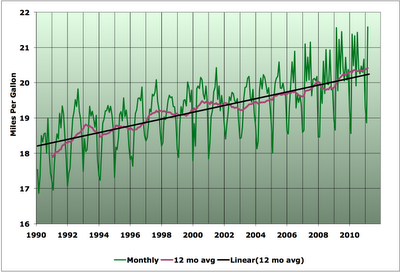
We used to be pretty good at improving gas mileage.

(Hat tip for this chart and the next to Early Warning.) In fact, from 1975 to 1990 mileage increased from 12 mpg to 18mpg. That’s the same percentage that President Obama and the EPA want us to improve by over the next 15 years. Is that realistic? The last 20 years show that we’ve only increased from 18mpg to 22 mpg, not nearly as impressive.

American vehicles are heavier and less efficient than equivalent vehicles in Europe. Europe’s fleet of cars averages 35 mpg, while America’s average is about 22 mpg. (Higher fuel prices incentivised innovation among car manufacturers and frugal prudence in European car buyers.) If we could magically raise our average mileage to European levels the amount of energy we would save would be more than 10 quads. That’s, umm, 80 billion U.S. gallons of gasoline. A year. U.S.refineries get about 19.4 gallons of gas out of a barrel of oil, so that’s 4 billion barrels a year, or 11.3 million barrels a day we wouldn’t burn. That’s how much we imported, total, in 2010.

So it’s realistic. It’s possible. And it would certainly help our balance of trade figures. And it would free up supply for the developing world, which badly needs it.

But here’s the thing. In 1975, when CAFE regulations were introduced mandating mileage improvements, mileage improved. But after the crisis, the price of oil dropped and the regulations sort of went away. Mileage stopped improving. If America is producing this oil domestically–even if prices don’t drop–will domestic energy companies resist higher mileage more strongly?

Kind of a lot more riding on this than the usual back and forth between the Energy Cowboys and the Environmental Brigades…

One Month Anniversary

Well, I’ve been doing this for a month and despite the lack of posting in recent days, I’m still loving it. I’ve managed to get 5,567  hits and 221 comments.

The report I started this blog to publicize has been downloaded by 20 of you–I hope more will take the plunge. In the meantime, I’ve learned more about global use of energy, which stubbornly continues to grow at 5% per year while everyone wants it to grow at half that rate.

And I’ll continue to beat that drum on this blog. Planners, politicians, economists and plain ol’ citizens are not getting the information we need to make good decisions that involve energy. This planet is going to use a lot more energy by 2030 (which is just around the corner) than the prognosticators have figured.

This means that those planning for one future will have to deal with another. And that means coal. The easy to get, easy to burn, easy to transport fuel that has worked so well for humanity over the past two centuries (except for those minor problems with health, habitat and the atmosphere…).

If we don’t prepare for the real amount of energy we need we will have no choice.

What China is doing to prepare for its energy future

China will need a lot of energy in the medium term future. I calculated their consumption at 247 quads in 2030, up from 100 quads last year.

China is working heroically to assure supplies of oil and coal. They are eagerly awaiting completion of Mongolia’s mega-mine, Tavan Tolgoi, as Mongolia is slated to produce 240 million tons of coal a year by 2040. None of that coal is expected to sit on the shelves gathering dust. China will burn it.

China has invested $15 billion in Canadian tar sands projects, happy to snap up the oil that is too dirty for American tastes.

China currently has 14 nuclear power plants, with 27 under construction. They have plans for a further 150 plants, and intend to build about 4 a year until they get to that figure.

China has other needs than energy–fresh water being among them. So China is working to kill two birds with one stone. “China already has half the world’s large HEP dams (25,800), which produce 213 GW of power. And while the west has mostly stopped building dams—the U.S. has only produced 80 GW of HEP in its history—China is forging ahead: Along the Yangtze River and its tributaries, 100 large dams are either being planned or built, and 43 additional dams are in the works for the Lancang (the Upper Mekong), Nu, Hongshui and Jiulong Rivers in China’s southwest.”

China is planning for a big future.